
Home Blog Page 22

Cobra Village: Scariest Place on The Planet ?

Can you imagine a place where all inhabitants keep King Cobras as pets? A place where cobras roam the streets as if they were cats and dogs?

Welcome to ‘Cobra Village’, whose inhabitants don’t keep chicken or ducks in front of their houses. They breed and rear hundreds of cobras instead, mostly just underneath or even inside their homes. They regard the most revered snakes on the planet – as part of the family. If you walk along the village streets, you will definitely see some deadly cobras and other snakes locked in cages, while others stroll the roads freely.
This unique village, located in Northeastern Thailand, is actually called Ban Kok Sa-Nga, but everyone knows it as ‘Cobra Village’.

What do the people of ‘Cobra Village’ do for a living? Very simply: They live and breath Cobras day in and day out. Most of the men are Cobra fighters, while some of the women are Snake dancers. They boast daily snake shows where you will see men literally fighting King Cobras, risking their lives for applauds, cheers and donations…

What happens if a Cobra bites?

Do they have any anti-venom for snake bites in the village? Well NO, they do not. Instead, they grow a special herb in their backyard, which they mix together with lemon juice and put on the snake bite wound. It’s called ‘Wan paya ngoo’, and villagers claim it will cure bites of any venomous creature, even scorpions. Remarkably, a report published on the website of the U.S. National Center for Biotechnology Information actually validates that ‘Wan paya ngoo’ is effective against the cobra venom. According to them, it contains some kind of unique molecule that can protect cellular proteins from the venom’s lethal enzymes. This ‘magical’ herb is actually the main product with which the villagers make their living, and they sell it in the Cobra show market.
Having all this in mind, there’s no wonder why ‘Cobra Village’ has become such a fascinating and popular tourist attraction, but how did it all begin?

The Story of ‘Cobra Village’

More than sixty years ago, a doctor in the village of Ban Kok Sa-Nga decided to fulfill his dream of transforming his small typical Thai village, into a unique tourist attraction. In his ambitious quest, the doctor surprisingly managed to persuade his neighbors to do something extraordinary: Raise snakes as pets in their houses and then perform with them in shows, to attract tourists. Today, every single home of the 140 families of ‘Cobra Village’ keep and breed at least one snake. Some of these snakes are among the deadliest in the world, such as King Cobras and various cobra species, while other snakes are a bit less dangerous, such as pythons and racers. It is quire astonishing, but even the children in this fascinating village are not afraid of snakes. They are taught already at young age how to handle, feed and rear snakes, and eventually, how to perform and fight them on stage. But how does someone grow up and live in such a place?

It sounds like a terrifying place to live and raise your children in. Wouldn’t you be constantly afraid of the next snake bite? Well, surprisingly the people of ‘Cobra Village’ are NOT afraid at all. They live extremely comfortably with all their snakes. Maybe some of the mesmerized tourists are terrified from time to time, but it seems that the village is always in ‘Gala’ mode, celebrating from one snake show to another. These Thai villagers have amazingly turned fear of Cobras and snakes into a unique happy festival, and most of the tourists love it.

The brave tourists who have the guts to watch the fight shows, can see how fearless snake handlers, some even in their 70’s, stand off face-to-face with King Cobras.

Watch this video of a Snake show fight in Cobra Village:

So if you really love snakes and reptiles, and you are ever in Thailand, do not miss the opportunity to visit this unique place where humans and snakes live together. “Cobra Village” is definitely worth the trip for any snake fan!

How to get there?

The “Cobra Village”, or Ban Kok Sa-Nga is located approximately 30 miles (50 km) northeast of Khon Kaen city. There are regular flights from Bangkok to Khon Kaen. When you get there, go to the city’s main terminal and take a bus to Ban Kok Sa-Nga. The bus stops a few miles from the village, and all you need to do is take a Tuk-tuk to reach the Cobras…
Tuatara Lizard-Like: Is This The Longest Living Reptile?

How would you like to live to be 200 years of age? Well, if you simply eat healthy everyday and transform yourself into a Tuatara, you might eventually make it…:-)

This extremely unique Lizard-like creature is found only in New Zealand,  and grows at the slowest rates among all reptiles. Its lifespan averages approximately 60 years, but the Tuatara Lizard-like can easily surpass 100 years of age. Some scientists even claim that captive Tuataras could live to be 200 years of age! Fascinating, isn’t it? You might say that Turtles can even live longer, as we covered in our post about the amazing research on the Painted Turtle. There are naturally debates between experts in this field of science, but one thing is sure: We can learn plenty from this spectacled lizard…

So who is the Tuatara Lizard-like Reptile?

tuatara lizard
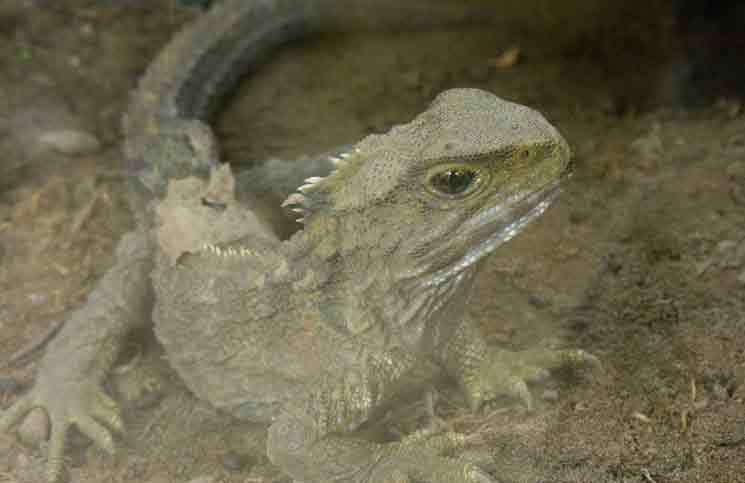
A Tuatara Lizard by Phillip Capper. CC 2.0

It might look like most lizards, but the Tuatara is the only living species of a distinct order of reptiles called Rhynchocephalia. Once upon a time, this group included a large variety of species dating back to the Mesozoic Era, 252 to 66 million years ago. That’s one good reason why these lizards are so popular among scientists studying the wonders of evolution. Here are some quick Tuatara Lizard-like facts…

Where did it get its name from? Its exotic name originates from the Maori language, and it means “peaks on the back”.

How can it survive in New Zealand? The Tuatara evolved throughout the years and has uniquely adapted to cold weather. This, in contrary to its ancestors and most reptiles who live in warmer climates. The Tuatara can still run and hunt at temperatures of 41F (5C)! This adaptation is what enables the Tuatara to survive and thrive on the islands of New Zealand.

When was it classified? It was 1831, when the British Museum received a Tuatara skull, that it was originally classified as part of the lizard family.

How does it look? It’s a green-brown and gray lizard-like reptile which reaches lengths of 31 in (80 cm) and can weigh up to 2.9 lb (1.3 kg). The body colors of the Tuatara match its environment, but can change over its lifespan.

Can the Tuatara break off its tail? Its back and tail may look more like that of a crocodile, but the tuatara, like other lizards, can indeed break off its tail whenever its in danger. It can also regrow it later on.

Can it hear? The Tuatara Lizard-like reptile might not have any external ears, and its hearing organs might be extremely primitive, but it can definitely hear. It shows a frequency response from 100 to 800 Hz.

Could you believe this primitive lizard has some super high-tech capabilities? Well, it turns out the Tuatara has advanced eyes that are equipped with a duplex retina and two sorts of visual cells, for both day vision and night vision. Isn’t that cool?

How does it navigate? The Tuatara also has the unique “third eye” (also known as the Parietal eye) which very few lizards have. Scientists claim this “third eye” is used as a sun-calibrated compass, which helps them navigate and find their way.

What does it eat? The Tuatara Lizard-like reptile will mostly eat beetles, crickets, and spiders. However, it will also put on its menu some frogs, lizards or bird’s eggs.

Who is its enemies? The Tuatara’s main enemy, like that of most animals, is Man. Deforestation and habitat loss are among its most formidable enemies. However, also predators such as the Polynesian rat are among its fearsest foes.

How does it defend itself? The Tuatara might be old and primitive, but it will surely defend itself, and its territory. It will threaten and even bite any potential enemy, and the outcome of this bite can mean serious injuries. The bite can cause serious injury.

How does it reproduce? Very similarly to birds, the tuatara male will lift the female’s tail, place his vent over hers, and inject the sperm into her body. They reproduce every four years. The amazing fact about this lizard, is that it can be sexually active at very old age. There is one Tuatara in the Southland Museum and Art Gallery in New Zealand, who is called Henry. He is 111 years old and still reproducing!

Watch this rare Video of a Tautara hatching:


Why is it called a “living fossil”? It also has a few unique features in its skeleton, some of which were possibly sustained through evolution from fish. No wonder why they are sometimes called “living fossils”.

Which of its organs is the most primitive? The brain of the Tuatara lizard-like reptile resembles that of amphibians, while its heart is actually more primitive than the heart of any other reptile on the planet.

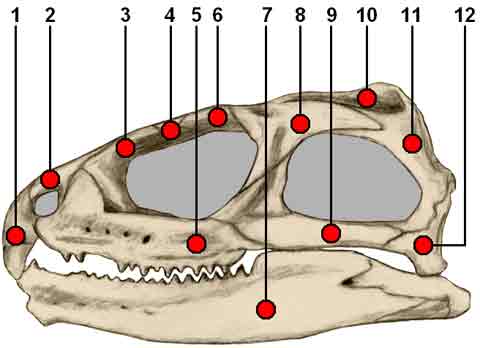
This fact will surely blow your mind: As you surely know, the skull of most extinct reptiles has changed and modified over the millions years of evolution. However, that’s not the case for the Tuatara. This unique reptile preserved all the original features of its skull, until this very day.


Tuatara Lizard
The Tuatara Lizard Skull. Drawing by Arthur Weasley

1 = premaxilla 2 = nasal 3 = prefrontal 4 = frontal 5 = maxilla 6 = postfrontal 7 = dentary 8 = postorbital 9 = jugal 10 = parietal 11 = squamosal 12 = quadrate

Can you pay with it? Until 2006, the Tuatara Lizard-like reptile was featured on the five-cent coin of New Zealand’s currency.

Is it God’s messenger? In some indigenous tribes across New Zealand, it is believed that the Tuatara is a messenger of Whiro – the God of death and disaster. In other places it is regarded as a special treasure. However, like many other exotic reptiles, the Tuatara is also in danger of future extinction…

Threats and Conservation

As mentioned, habitat loss and predators such as rats are threatening the existence of this remarkable reptile. The Tuatara, which is protected under the law since 1985, was once present on both the Northern and Southern islands of New Zealand. Today however, there are islands where it is hardly breeding and rare to find.

In 2012, one of the most complicated projects to repopulate the mainland of New Zealand with the Tuatara, took place. Approximately 260 Tuataras were relocated from Stephen’s Island to various locations across New Zealan, such as Cape Kidnappers, Young Nick’s Head, Orokonui and Maungatautari. It was the largest transfer ever performed for this ancient lizard-like reptile.

Watch this video about the Tuatara Relocation project:

Other than that, there are several breeding programs in New Zealand that are trying to conserve and breed the tuataras, such as the Victoria University of Wellington, the Southland Museum and Art Gallery, or the WildNZ Trust which has a a tuatara breeding enclosure at Ruawai. Let’s hope they all succeed in saving this unique reptile from extinction…

Want to know more about Lizards? Read our great Lizard Facts post…

Florida Snakes – Are These The Deadliest?

florida snakes
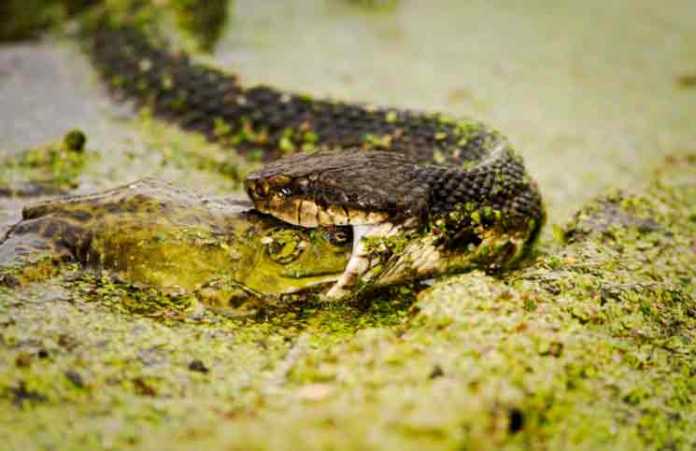
The Fearsome Water Moccasin eating a Frog. Photo by Paul Wolf

If you have any plans to search for Snakes in Florida, read this…

First thing you should know is, there are more than fifty types of Florida snakes that you would encounter in the beautiful sunshine state. Each of those types also has some variants as almost every species has some genetic and mutative tendencies that make them slightly or considerably different. While there is no dearth of Florida snakes, you will not come across many venomous snakes in Florida. More than forty five types among the fifty four odd snakes found in the state are actually non venomous snakes in Florida. However, dangerous encounters with deadly snakes do occur in Florida, as this little boy from Miramar, Broward County, will surely testify…

Early this November, 9-year old Jorge Quinonez was playing outside with his brother and a friend, when he suddenly fell down right on top of a Water Moccasin Snake (that’s the scary snake in the picture above, devouring a frog!). It’s the world’s only semiaquatic viper, it’s venomous and capable of delivering a painful and fatal bite. The snake’s natural reflex was of course to defend itself, and so it did. It instantly bit little Jorge and bore its fangs into the poor kid’s hand, while he was screaming out loud. Luckily the tough kid swayed his arm around and made the snake lose its grip. He then ran to his dad who called 911. They rushed him to the hospital, where Miami-Dade Air Rescue flew in its Venom Response Team to treat Jorge. They immediately injected him with the anti-venom. As his condition stabled, Jorge received a 2nd round of anti-venom. Several days later he was released, and back to school. Jorge survived, but you better know your snakes in Florida…
Watch this great clip where Central Florida Zoo & Botanical Gardens chief herpetologist Nick Clark talks about the four species of venomous snakes that live in central Florida:

Who Are The Deadly Florida Snakes?

So you already know the ferocious Water Moccasin (also known as Cottonmouth) who bit 9-year old Jorge. Other venomous Florida snakes are the Eastern Diamondback Rattlesnake, Timber or Canebrake Rattlesnake, Dusky Pigmy Rattlesnake, Coral Snake and the Southern Copperhead. Here are some basic facts about each that might help you recognize them, if you ever really go searching for some Florida Snakes…

The Cottonmouth or Water Moccasin has a very heavy body. It is dark and has reddish brown cross-bands on a brownish skin. When these snakes get old, they tend to become darker and thus blacker. An adult cottonmouth is usually two to four feet in size. I wouldn’t recommend getting close to this monster…

The Eastern Diamondback Rattlesnake is also a heavy snake and is larger than the cottonmouth. The eastern diamondback is usually three to six feet in size. Characterized by its cream borders and brown centers, the eastern diamondback rattlesnake has a brownish or gray tail.

The Timber or Canebrake Rattlesnake is often confused with the eastern diamondback but they are different. The canebrake is also a large snake but it has reddish brown stripes along the center of its back. This is the unique attribute that makes it different from the diamondback. There are cross-bands, usually like chevron which are black and large. The timber or canebrake rattlesnake is usually three to five feet in size. It has a large head just behind the eyes or in a diagonal line with the eye.

The Dusky Pigmy Rattlesnake is a small snake. It is two feet at its largest adult size, making it one of the smallest Florida snakes among the venomous ones. The pigmy rattlesnake has a triangle shaped head and has nine scales, quite large ones. Considering its length, the dusky rattlesnake is quite fat, or thick. Its natural body color is dark gray and the pigmentation of gray varies according to age.

The Coral Snake is also among the smaller venomous Florida snakes. Its size ranges from a little less than two feet to about two and a half feet. It has black, red and yellow rings. The yellow rings are smaller and separate the larger black and red rings.

The Southern Copperhead has a stout body, gray or brown cross-bands and is at its largest at about three feet in size.

As I said, this is definitely just the basics of recognizing dangerous species among these fascinating Florida Snakes.

For a more detailed identification process, you can check out the ‘Florida Museum of Natural History” page of “Identify a Florida Snake”

You want to read some fun facts about Snakes? Click here!

Desert Snakes: Meet The King and His Friends

Deserts may look great on Discovery or National Geographic and they certainly entice you when a movie brings the Middle Eastern ambience and vibe into your living room or at your theaters. But deserts can be the most challenging of all places on earth. Imagine living amidst sand, without water or any vegetation and having dust storms and dunes for company. Spend one day in the life of a camel and you would lose all the interest you have in the mystic lands of the pharaohs, pyramids and the modern day Burj.

Desert Snakes: Do They Need Water?

In challenging conditions, some animals tend to thrive. The camel survives in the desert with élan, just as the fishes in the glacial regions of the world and the birds in the urban landscape where they seldom have anything to cherish. Desert snakes are also among the ultimate survivors in the world. Just as it is difficult to kill a cockroach and no bug spray seems to be conveniently effective to go for the kill immediately, some desert snakes can survive all odds and stay alive, at times with no food and certainly no water.

The Desert King Snake (Lampropeltis getula splendida) is one of the few ultimate survivors known to man. It can survive in arid and semi arid areas. The species is particularly known to thrive in New Mexico, Arizona and Texas. All three states are charming in their own right but can be quite unwelcoming in many ways. But as nature would have it, the desert king snake does not tread to territories where they would not get any food or water. You will not find a desert king snake a hundred miles away from the nearest water source. This is why desert snakes have moved closer to water sources which may be away from the core desert area or they have moved closer to human establishments.

Watch this video by Orry Martin, The Texas Snake Hunter, as he shows us the King of Desert Snakes, known as the ‘Desert King Snake’:

Who are the most common Desert Snakes?

There are hundreds of different species of desert snakes that live and survive in these hottest and driest places on earth. The most well-known are with no doubt the Rattlesnakes, which are extremely venomous and among the scariest snakes out there. Their family of species is quite large, including the Mojave Rattlesnake, the Western Diamondback Rattlesnake, the Grand Canyon Rattlesnake, the Great Basin Rattlesnake, as well as the Speckled Rattlesnake, and more. On top of the rattlesnakes, you might find the Desert Rosy Boa snake, the Arizona Milk Snake, the Sonoran Gopher Snake, and many more. Today, it is easier to find desert snakes in rural areas or partially wild areas than in the most challenging of environments.

The same applies to rattlesnakes which are on the dietary chart of the desert king snake. The desert king snake also gorges on rats and lizards – rodents in general, but those are also hard to find when you swim on an ocean of sand or dust. Naturally, being close to the humans pays off.

Some of these ultimate desert snakes survivors, especially the desert king snake is also domesticated since it isn’t venomous and doesn’t attack humans and instead feeds on other smaller snakes which are venomous. It responds extremely well to interactions with people, and is even considered gentle. That’s why it has become such a popular pet snake. Almost all pet Desert King snakes are bred in captivity, so they are very easy to care for. However, Desert King snakes are also known to be “escape artists”, and as a pet owner, you will need a tight enclosure to make sure your snake does not suddenly disappear…

In July 2013, an English family in London got the fright of their lives as a 3 feet Albino Desert King snake slithered out of their chimney. It managed to wrap itself around an ornament, before three police officers arrived to the scene armed with a takeaway pizza box and a little gaffer tape. It took them at least one hour to capture the ultimate survivor snake, who most probably escaped from a home where it was kept as a pet. So you tell me, is this a valid candidate for King of all Desert Snakes?

Need more details on the Desert King Snake? Check out this page of the Tucson Herpetological Society.

Looking for some more fun facts about Snakes? Click here!

Is This Deadly Sea Snake a Cobra Relative?

Meet the Yellow-Bellied Sea Snake

In recent months, one of the deadliest sea snakes on the planet has been observed numerous times near the beaches of Costa Rica. It’s been spotted far more frequently than ever before. On some occasions, the ferocious Yellow-Bellied Sea snake was even seen swimming up close to surfers and swimmers. Several scary encounters were also reported to the local media. The Yellow-Bellied Sea snake is known for its powerful neurotoxic venom which it uses to hunt and paralyze fish. So far, there have never been any human fatalities recorded from bites by this unique sea snake, who is also known to be an old cousin of the Cobra…

His scientific name is Pelamis plature, but it’s better known as the Yellow-bellied sea snake or the Pelagic sea snake. It is usually found in tropical ocean waters, and is the only member of the Pelamis genus, which is related to the Elapidae, the famous Cobra Family. It is said to have evolved from the terrestrial Elapids approximately 10 million years ago. One factor in which he resembles the Cobras is his highly powerful venom, which yields 1.0-4.0 mg per bite. When bitten by a Yellow-bellied sea snake, the poor prey will usually suffer from neuromuscular paralysis and even direct kidney failure.

Is there an Anti-venom against the Yellow-bellied Sea Snake?

In Costa Rica for example, despite being very advanced in the research and production of various antivenin, you will not find anti-venom for the Pelamis plature. The reason is quite simple: No human has ever been bitten by this Cobra related Sea Snake. Following the frequent sightings of the snake along the beaches of Costa Rica, the authorities might be propelled to change the situation. However, the Australian Commonwealth Serum Laboratories ltd. in Melbourne does possess anti-venom that can neutralize the venom of the Pelamus plature.

Watch this strange video of the knotting and coiling behavior of a Yellow-bellied snake:

Fast Facts about The Yellow-bellied Snake

  •   The Pelamus plature has a narrow head and a compressed body, which reaches total lengths of up to 28 inch (72 cm) for males and 35 inch (88 cm) for females.
  •   Its color design will usually be black on the upper part and yellow on the lower belly part. In some cases there are black spots found on the yellow belly.
  •  It is pretty much helpless on land, and occasionally will form large groups of thousands of snakes in surface water.
  •  It does not have the ability to filter the salt of the seawater, so in order to drink, it will wait weeks or even months until it rains. It will then drink the rain water.
  •  It is very widely distributed, specially in the Pacific Ocean, and is actually the only sea snake that has reached the Hawaiian Islands. It has even been spotted along the beaches of New Zealand, where authorities in 2012 issued a warning to swimmers. They asked them not to be surprised if they spot a venomous snake swimming beside them, which is related to the notorious Cobras. However, the Yellow-belly snake, like other sea snakes, is not found in the Atlantic ocean, the Mediterranean, nor in the Red sea.
  •  It is completely pelagic and able to live and give birth in the ocean. It travels with surface ocean currents and hangs around drifting logs and seaweed, hunting the helpless fish that swim in the area. After biting a fish, it will devour it head first…
If you ever see or meet this snake while swimming, stay away! It will not hurt you if you do not bother him…

For more fast facts about Cobras click here.

For further discussion on snakes, scientific classifications, venom research and much more, check the resources available in “The New Encyclopedia of Snakes”, available on Amazon.com.

069113295X
Click here to take a glimpse at 
“The New Encyclopedia of Snakes” 

[dropcap type=”1″]1[/dropcap]If you feel like a having a real Book on Snake Bites, then get this book:Snakes and Snakebite‘ by Visser, J. & Chapman D.S.

[dropcap type=”1″]2[/dropcap]And if you love African Hot snakes, this is THE Book for you:  ‘Dangerous Snakes of Africa’ by Spawls, S. and Branch, B.

Dwarf Caiman: The Perfect Croc Pet?

Dwarf Caiman
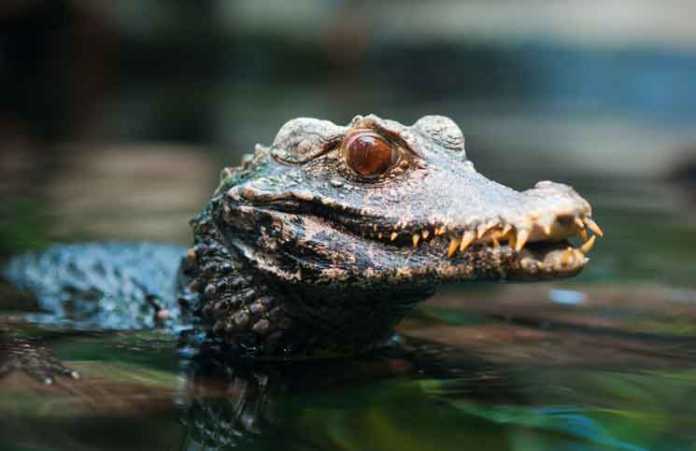
The Perfect Croc Pet? Dwarf Caiman. Photo by Enjoylife25

Crocodiles are always perceived to be large, terrifying and extremely powerful. Those who have read about the saltwater crocodile and have seen movies like Lake Placid would always wonder if there are any crocodiles out there that are not so terrifying. Well, quite contrary to the perception about crocodiles, there are many small crocodilians that do not terrify people as much as the larger species There are several species of crocodilians that are relatively harmless or less threatening, and are even kept as pets!

Not all crocodiles grow as long as 23 feet and weigh a ton. There are crocodilians that weigh only a few kilograms and are barely three or four feet in size. One such crocodilian is the Dwarf Caiman. The Dwarf Caiman is also known as Cuvier’s dwarf caiman. The scientific name is Paleosuchus palpebrosus, and it is regarded as the smallest of all crocodilians, and is the smallest species in the alligator and caiman family. This small crocodilian can be found in central and northern South America, Brazil, Bolivia, Colombia and Ecuador, Guyana, French Guiana, Peru, Paraguay, Venezuela and Surinam.

The Dwarf Caiman usually thrives in forested areas where there are many lakes or rivers. Large ponds, monsoon ridden areas and tropical regions that receive a lot of rain and thus remain submerged or have swampy lands are also ideal for the Dwarf Caiman. This remarkable crocodilian can thrive well on dry lands and marshy areas, warm waters and cool waters. If you look at it with the right eyes, you will notice that the Dwarf Caiman actually looks more like an alligator than a crocodile.

dwarf caiman
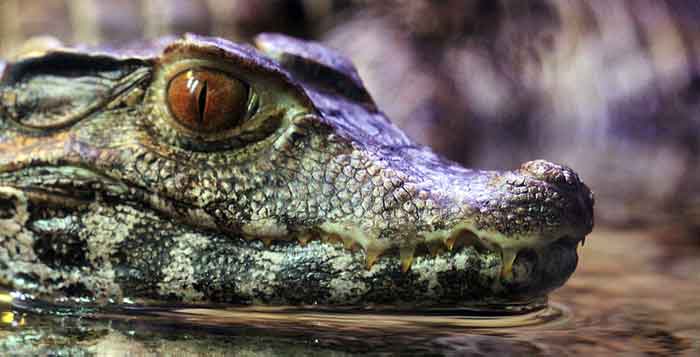
Dwarf Caiman. By Karelj. CC-BY-SA-3.0 or GFDL via Wikimedia Commons

Also known as the musky caiman, Cuvier’s caiman (named after the French zoologist Georges Cuvier who identified the species in 1807), the dwarf caiman’s tiny size makes it a great crocodile pet. A male Dwarf Caiman would usually reach an average length of 1.4 m and would weigh about 7 Kg. The female crocodilian would be about 1.2 m in size and would weigh a little less. A matter of fact, this Caiman has become quite popular worldwide, partly thanks to a guy by the name of Shaun Fogget.

In 2012, Shaun Fogget, who starred in the popular TV series Croc Man, and today owns Britain’s only crocodile zoo, managed to breed 24 dwarf caiman crocodiles. This was part of a record conservation and breeding program of Fogget’s Zoo. He fed the parents caimans with special vitamins that helped make it such a successful breeding. Fogget removed the eggs from the burial place and kept them at a constant 30⁰C for a little more than three months days, until they hatched. He fed the baby Caimans with insects such as locusts and crickets until they were ready for dead rodents and small chickens. In the same year, just several weeks before the Caimans birth, Fogget became the first private breeder who managed to breed 14 West African dwarf crocodiles. Foggett began keeping reptiles at the age of 15, and after learning all what he could about crocodiles, he started to keep them privately, before selling his house to build the first and only crocodile Zoo in the U.K. His wildlife documentary TV series, ‘Croc Man’, became hugely successful, with more than 1 million viewers for its final episode in August 2011.

Watch this BBC clip about Fogget and his Crocodile Zoo:

While the Dwarf Caiman may appear to be a vulnerable crocodilian since it is light and small in size, it is not that weak. The body armor is made of bones atop the dermal scales, just like larger crocs or alligators. The armor is thick enough to protect the crocodilian from predators of various natures. The thick bony armor is also strong enough to ward off attacks by humans. However, unlike larger crocodilians, the Dwarf Caimans are vulnerable to bullets and metallic spears, and like many other species, they are threatened by humans.
In a time where pollution, mining projects, a booming Pet Trade industry and habitat destruction are all threatening the Caiman’s existence, this conservation program of Shaun Fogget should be admired and supported by all who can.

WANT TO DISCOVER THE MIGHTY KING COBRA?
VISIT OUR KING COBRA PAGE!

Html code here! Replace this with any non empty text and that's it.

Do Snakes Drink Water? WATCH THIS!

We know how snakes can eat about any animal on this planet (well – not exactly, but almost), but do snakes drink water? The common belief is that snakes get most of the water they require from the rats, mice and other animals they catch and devour. David Cundall of the Lehigh University in Bethlehem, Pennsylvania, believes that skin creases in the snakes lower jaw help them drink. He claims that their tongues are too small to lap up water, and that they are covered in a sheath that will prevent them from lapping up water even if they were larger. In addition to all that, Cundall states that in contradiction to humans—snakes cannot tip their heads back to drink water. According to Cundall, snakes have a different system to drink water, which involves the skin folds which function like tiny tubes in a sponge, drawing water into the snake’s mouth through capillary action. The snakes muscle’s action then squeezes the water down its gut.

Snakes seldom actually drink, so it is believed. Those snakes who live in harsh climates such as deserts, where water can hardly be found, will spend their lives without having one drink.

However, snakes do have the capability to absorb water as mentioned above, and even drink it, as you’ll see in this amazing video of a Cobra snake being fed by a person. It actually drinks water from a can! Researchers even discovered that Boa Constrictors had the remarkable ability to suck water through a very small hole in their mouths, similarly to drinking through a straw. However, when tested in the Lehigh University, on other species of snakes, no evidence was found of any suction of water.

Well, despite the wise assumptions of scientists with which I mostly agree, this fascinating video clip from India pretty much answers the question of “Do Snakes Drink Water”, with a big “YES” .

If you liked this, you should read our post on “What Do Cobras Eat?”.

For more fast facts about Cobras click here.

And if you haven’t read our King Cobra Page yet, click the image below…

cobras

For further discussion on snakes, scientific classifications, venom research and much more, check the resources available in “The New Encyclopedia of Snakes”, available on Amazon.com.

069113295X
Click here to take a glimpse at 
“The New Encyclopedia of Snakes” 


Water Cobra: The Most Secretive Species?

A white man appeared at dawn, and Werner and Wally asked him what in hell he was doing there.
“Catching snakes. My business. And you, sir, are sitting on one of them. They’re very delicate, you know. Kindly get off that sack.”
Von Alvensleben did a maneuver that would have won him a gold medal in any Olympic competition, the Baron bailing off the hood like a demented dervish. There, in the sack on which he had been sitting and sleeping, was a Banded Water Cobra, Boulengeria annulata. Why it had not bitten him through the rough cloth is anybody’s guess. Maybe just luck.
There is no known antivenin. (A short excerpt from the fascinating biography of Walter Walker “Wally” Johnson, ‘The Last Ivory Hunter: The Saga of Wally Johnson’. You can read more about the book here.)

water cobra
The Last Ivory Hunter: The Saga of Wally Johnson. CLICK FOR MORE INFO!

Wally Johnson was a professional ivory hunter during a time when elephants inflicted terror on the Mozambique countryside, destroying crops and killing villagers. Wally was one of the best and last true hunters. He spent half a century in Mozambique hunting for “White Gold”. He shot nearly 100 lions, 1300 elephants and probably 2000 buffalos. In the book, author Peter Hataway-Capstick tells the memoirs of Wally, his African bush adventures, his awe-inspiring stories and encounters with charging Elephants, Buffalos and the deadliest snakes of Africa.

One of these majestic snakes is with no doubt the Naja annulata (formerly Boulengerina annulata), better known as the Banded Water Cobra or the Ringed Water Cobra. Don’t mistaken it with the Banded Water Snake, which is a species endemic to the southern United States. The unique water cobra on the other hand, is native to western and central Africa, and together with the Congo Water Cobra, it is one of only two species of water cobras in the world. This aquatic species rarely ever wanders far away from water, and hardly ever shows itself to humans. It is regarded as one of the most secretive cobras on the planet.

Watch this amazingly rare encounter with a Ringed Water Cobra:

Really no anti-venom against Banded Water Cobras?

The Naja annulata is a fairly large and heavy snake with a short and flat head. Adults can reach maximum lengths of 9 ft (2.7 m), and the fact they spend much of their time in water can be seen on their scales, which are very smooth. The Banded Water Cobra can be found in numerous African countries, from Angola, Congo, Gabon up to Cameroon and more. There, this Water Cobra will mostly hide in bushy and wooded banks along rivers and lakes, keeping themselves constantly under the radar.

Despite their secretive way of life, the Naja annulatas are usually more active during the light of day, and most of their time is spent in the water. They are able to dive to depths of 82 ft (25 m) and stay underwater for up to 10 minutes. On land however, they move slower and will usually hide in the bushes of the river banks, in holes or underneath rocks. Like most Cobras, they will attack and bite only if they feels threatened. Their menu of prey predominantly includes fish, although they might also devour some toads or frogs from time to time. As mentioned in Wally’s biography, the venom of the Naja annulatas is not well known, and is mainly neurotoxic. According to all our sources, there is currently no specific anti-venom produced against this mysterious cobra species.

The stranger opened the bag and poured out the snake, which really put on a performance. In a second bag, he also had a black mamba, which he teased with a stick, somewhat to the discomfort of Wally and Werner. Finally, he put the snakes back in the bags, thanked the men for keeping an eye on his car, and went on what I hope was his merry way. (Another short excerpt from the biography of Walter Walker “Wally” Johnson, ‘The Last Ivory Hunter: The Saga of Wally Johnson‘. You can read more about the book here.)

069113295X
Click here to take a glimpse at 
“The New Encyclopedia of Snakes” 


Philippine Cobra: Deadliest on the Planet?

In 2011, a young man was brought to the hospital in the city of Cagayan de Oro, Philippines. The man was in extremely poor condition, not able to speak or tell the doctors what even happened. The only information that his family members could provide was that a snake had bitten him. The filipino doctors were baffled. In order to treat the snakebite, they had to know what snake it was. The task was tough, since the tropical nation of the Philippines and its perfect snake-habitat climate is home to dozens of exotic and deadly snakes.

What snake was it?

The doctors and nurses were racing against time, while the patient was going into respiratory arrest. Fortunately, they managed to identify “neurotoxic manifestations”. Meaning—symptoms that affected the nervous system of the patient. Meaning—the snake had neurotoxic venom. People bitten by a neurotoxic snake can die in less than an hour. Filipino Experts claim the only snake in the Philippines that contains a neurotoxic venom is the notorious Philippine Cobra (Naja Philippinesis), a notorious species of Spitting Cobras. Knowing that, the doctors deployed all possible treatments to save the young man, and he survived.

There are three species of spitting cobras that are native to the Philippines: the Equatorial Spitting Cobra, The Southeastern Philippine Cobra, and the Northern Philippine cobra, known also as the Philippine Cobra. This breath-taking snake, according to countless online sources, is the 3rd most dangerous snake in the world, and the deadliest Cobra on the planet. It can spit venom to amazingly long distances, even reaching 9.8 feet (3 meters). And it hits targets dead on. These deadly snakes are native to the northern parts of the Philippines, mainly the islands of Luzon, Mindoro, Catanduanes, and Masbate. Like many other snake species, this deadly Cobra prefers to live in close proximity to water sources, be it lakes, rivers or ponds. It will mostly eat a menu consisting of frogs, mice, small rats and lizards, or even other snakes. Its predators are the famous Mongoose, birds, humans of course, and even his mighty relative, the King Cobra.

philippine cobra
The Philippine Cobra. Photo by Mario Lutz. CC-BY-SA-3.0 via Wikimedia Commons

Philippine Cobra: The Venom

Among all Cobra species, Toxicological experts claim that Philippine Cobra possess one of the most toxic venoms. One bite from these deadly “sniper” Spitting Cobras can kill a person within half an hour. Their venom has the deadly ability to interrupt the transmission of nerve signals and to cripple respiratory systems. Only the Caspian Cobras (Naja Oxiana) are known to produce a more powerful venom than that of the Filipino species.
In August 2012, a Filipino Zookeeper in the Cebu City Zoo in the Philippines, tried to grab a Philippine Cobra but got bitten in his hand. The alarmed Zookeeper reportedly sucked the venom immediately, but then—swallowed it. In less than half an hour he was unconscious. He was rushed to the hospital, but shockingly there was no anti-venom available in the city of Cebu. The closest hospital with stocks of the anti-venom was in the island province of Camiguin, 256 miles (162 km) from Cebu. Luckily, a private airline by the name of Aviatour came to the rescue, and managed to deliver the anti-venom in time. The Zookeeper survived.

Snake Bites by the Philippine Cobra is a common cause of death among Rice farmers in this tropical country. According to a research by the U.S Naval Medical Research Unit, the death rate from cobras bites was estimated to be as high as 107.1 deaths per 100,000 per year at one site. Approximately 98% of the research victims were males, and only 8% of them reached a hospital.

For more fast facts about Cobras click here.

For FASCINATING facts on the King of all Cobras, click the image below:
cobras

For further discussion on snakes, scientific classifications, venom research and much more, check the resources available in “The New Encyclopedia of Snakes”, available on Amazon.com.

069113295X
Click here to take a glimpse at 
“The New Encyclopedia of Snakes” 

Albino Cobra: Rarest Snake in the World?

Albino Cobras
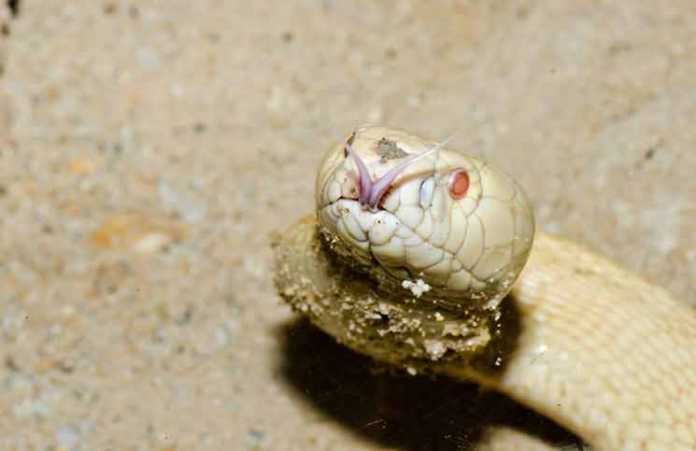
The legendary Albino Cobra. Photo by Kobchai Matasurawit

Have you ever seen white Cobras in your life?

Well, you might have seen one or two on TV, or on the net, but these legendary Albino Cobras are extremely rare. The popular Chinese news portal, China.org.cn, crowns the Albino Cobra among its Top 10 rarest albino animals in the world. Albinism in general, among animals, is quite rare. Since ancient times they have fascinated us with their awe-inspiring bright white color. Millions of people around the world see them as amazingly beautiful creatures, as they draw huge crowds in almost every Zoo. Some cultures even regard them as sacred, but as a matter of fact, Albinism is a severe disorder that practically robs the skin of color.

For most albino animals, including the Cobras, this rare disorder can become life-threatening as it leaves them without any camouflage, exposing them to predators and enemies. On top of that, add the health factors such as skin cancer that might develop from having ultra white skin. All in all, it definitely isn’t easy to be an albino animal. It would seem logical that these Albino animals need our help and protection, especially if in captivity, but in some rare media stories it is actually portrayed falsely that humans, or other animals, would need protection from the Albino…

Just this last September, a deadly Albino Cobra escaped captivity and ran loose for days in California. In the early stages of the chase, it was reported that the snake had bitten an innocent dog on its path, until it was captured by Animal Control officers. The venom of Cobras can kill within one hour.

It’s needless to mention, that there are hundreds of snakes incidents and snake bites every week across the world. None really make it to the news. However, this story of the Albino Cobra drew so much attention in the media (just google this: “Albino Cobra California”), that it blew my mind away. At least three Twitter accounts were opened just for this runaway Cobra, getting almost 300 followers by the time it was captured. TV reports even showed the Animal Control officers in the midst of their chase using tongs to catch the poor white snake. The Cobra didn’t even hurt anyone. It later turned out that even the dog escaped without a bite, and was actually only hurt while trying to escape from the mighty snake. So why did this Snake become such a media sensation? Is it only because of its perfect white skin?

I guess so.

Want to see the Media-sensation of the Runaway Albino Snake? Watch this L.A Times News clip on YouTube covering the story.
Also ABC covered the story, as you can watch here: 

https://www.youtube.com/watch?v=s0F8i1k0RAU

Are Albino Cobras Born White?

The young Albino Cobra is actually born in various colors, and only as it grows and ages it slowly turns lighter and lighter, until it becomes completely white. Native to India, China, Vietnam and other parts in Southeast-Asia, these snakes are known in the scientific world as the Monocled Cobras. This hardly used name was given to them for their O-shaped Monocellate Hood pattern, but the Albino Cobra is definitely a much more notorious and cool name. An adult snake can reach lengths of up to 8 feet, and is usually found in habitats that have water, such as mangroves, swamps, or near lakes, but also in forests and grasslands. The Albino Cobra usually hides in tree holes and places where it can find a nice menu of rodents. Like most Cobras in the wild, it will only strike and attempt to bite if threatened. But when it does, you better not be around. The Monocled Cobra is extremely venomous, with a powerful bite that produces both neurotoxic and cytotoxic venom, causing necrosis and respiratory failure that can quickly lead to death.

However, despite the fear and how dangerous they might seem to us, these White Cobras are extremely important to the ecological cycle of the environments they live in. The fact they eat various sorts of rodents helps to keep and control the rodent population in cities and villages across Southeast Asia. Sadly, these fascinating snakes aren’t respected by humans as they once were. Rapid economic growth in India and China brought about deforestation and habitat destruction, decreasing the numbers of these beautiful rare creatures.

For conclusion, just to remind you on the “Breaking News” of September—it is illegal to own Cobras in California, and the owner of the runaway Albino Cobra that became a Media Star, has never been caught.

In case you feel like getting a FREE Snake Bite First-Aid after reading this, just click here.

For more fast facts about Cobras click here.

For further discussion on snakes, scientific classifications, venom research and much more, check the resources available in “The New Encyclopedia of Snakes”, available on Amazon.com.

069113295X
Click here to take a glimpse at 
“The New Encyclopedia of Snakes”