
Home Blog Page 14

National Service Dog Month – Help Us Celebrate Service Dogs in September

National Service Dog

September is National Service Dog Month, a time dedicated to raising awareness and showing appreciation for the extraordinary work service animals do every day for the people in their care. National Service Dog Month honors these working dogs for making millions of lives better and safer.

As partners and companions to our human species, dogs understand us and can read our emotions. They have intrinsic therapeutic capabilities. Even an untrained dog can be an emotional anchor for a person with anxiety or depression, but a trained service dog can bring specific techniques to bear.

Help us celebrate and spread the word about service dogs and all the amazing things they do for us during National Service Dog Month in September!

Service Dogs: Working Canines Who Deserve Our Thanks

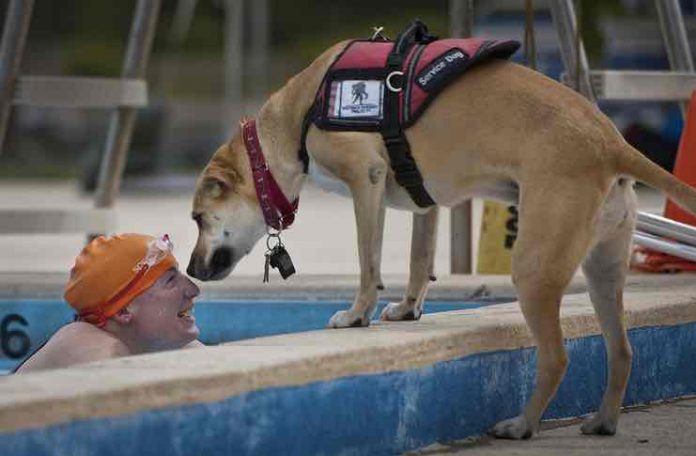
Service dogs help those with debilitating medical conditions, from autism to blindness, seizure disorders and hearing impairments, diabetes and those who need physical assistance, and they also serve our wounded warriors suffering from conditions like PTSD, traumatic brain injuries, and mobility issues.

Service dogs provide companionship while inspiring confidence, and they live to serve, protect, and assist their handlers. They help their humans perform tasks, overcome disabilities, and live fuller lives.

Service Dog
They also serve our wounded warriors suffering from conditions like PTSD

All of these animals dedicate and often risk their lives to help their humans.

Where Did National Service Dog Month Start?

Originally called National Guide Dog Month, National Service Dog Month was established in 2008 by actor and animal advocate Dick Van Patten.

After a visit to Guide Dogs of the Desert in Palm Springs, Van Patten was so inspired that he launched a fundraising drive to benefit guide and service dog training schools throughout the country.

What began as a single fundraiser evolved into an annual celebration of the extraordinary work that service dogs do.

Where Do Service Dogs Come From?

Many service dog organizations have a twofold objective: to provide a trained companion animal for people in need and to save an animal’s life by using rescue animals for this work. With thousands of dogs dying in shelters every year, simply because they are homeless, it’s a perfect partnership.

Dozens of organizations look to shelters for rescue animals who can have another chance at life as service companions.

Animal Farm Foundation is one these groups. They’ve established a service dog training program so rescued Pit Bulls can train for work traditionally reserved for other breeds.

Dozens of other organizations are training service dogs to meet specific needs:

  • Canines Companions for Independence
  • Canines for Disabled Kids
  • Guide Dogs of America
  • Patriot Paws
  • Best Friends Animal Society

Service dogs are therapeutic and train to help their owners manage a variety of physical and emotional disabilities. They have a legal right to go everywhere in support of their person. They deserve a month for us to celebrate their work and honor these loyal companions who make life better for so many of us.

Will you help us celebrate National Service Dog Month in September? Have you ever relied on a service dog for assistance? Let us know in the comments below!
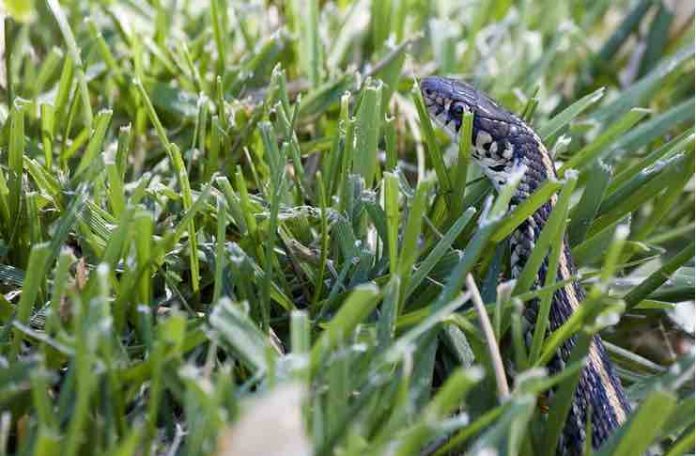

Tips for Keeping Your Dogs Safe from Venomous Snakes

Keeping Your Dogs Safe

Caring for a dog is a big responsibility. You can find many guides online, like from The Pampered Pup to tell you the best dog foods, or the best flea collars. But many people don’t know the best ways to keep your dog safe—especially when it comes to snakes!

You should know that when you walk your dog or let them play in the backyard, there is always a possibility they could encounter an unsafe situation. All pet owners should know how to identify venomous snakes, and how you can keep your dog away from them in the future! Here’s everything you need to know to protect your pet.

What do venomous snakes look like?

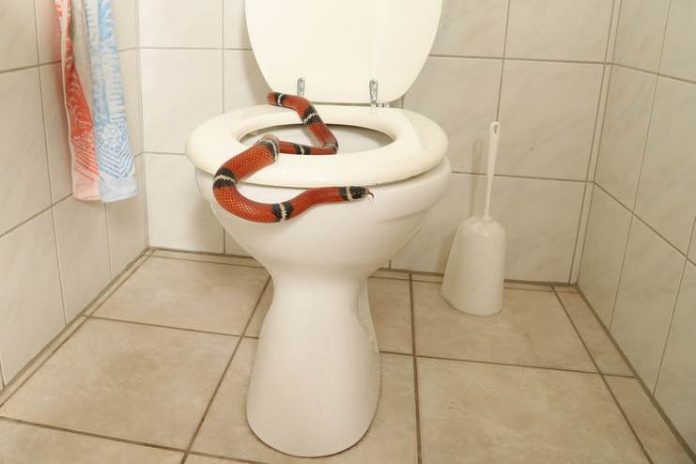
There are many different kinds of venomous snakes throughout North America. Though they vary in appearance, there are some key signs to tell whether or not a wild snake is venomous.

·       Most of the time, a venomous snake will have a varying color pattern. If you see a snake that is one solid color, it is most likely harmless.

·       Venomous snakes have a triangular-shaped head. Harmless snakes will have a more rounded head. This is because the venom glands require more room in a snake’s head.

·       Venomous snakes have rattles. If you see a snake with a rattle, it is the venomous rattlesnake. Some harmless snakes copy the rattling noise but lack the actual “rattle” on the end of the tail.

·       There will also be a possible heat sensor in dangerous snakes. These heat sensors look like a small depression on the head, and are called “pits” (which is where “pit viper” comes from) Not all dangerous snakes have a pit, but if it does, it is a dangerous snake.

Even if you don’t know how to identify these snakes in the wild, you should treat every snake you see as a venomous one. This is the best way to ensure that you don’t get poisoned or get your dog into trouble.

So how do I keep my dog safe?

Ensuring that your dog is safe in your backyard or on a walk is relatively straightforward. You can use training techniques or control your environment to help them stay safe. Here are the best methods to keeping your dog safe from snakes:

1.     Teaching them to “leave it.” This means that the dog will be able to respond to a command such as “leave it” when they need to turn their attention away from something. Start of teaching your dog to ignore smells, toys, and other dogs. Then you can train your dog to ignore snakes in controlled environments with real snakes.

2.     Keep a short leash. When you’re on a walk, a shorter leash can give you more control over your dog and where they walk. It may take a few walks for your pet to get used to it, but making sure they are close to you is a great way to monitor them.

3.     Remove any wood from your backyard. If you find that you have snakes in your backyard, get rid of any piles of wood where snakes may live in.

4.     Fence and chemical barriers to keep snakes out. Solid fences can prevent them from sneaking through. Combining this with snake-deterring chemicals can help your dog run freely in the yard once more.

In conclusion

As a responsible pet owner, keeping your pets safe should be your number one priority. Always keep in mind these signs to tell dangerous snakes apart from harmful ones, and make sure you take the proper precautions against these snakes with training or environmental control. Do this, and you won’t have to worry about your pet getting hurt.

Five Most Incredible Dog Breeds

Incredible Dog Breeds

Man and dog have lived together for thousands of years. These shaggy beasts have helped us hunt, guarded our houses and looked after our livestock. Over time, technical progress has made many of the functions our four-legged friends performed obsolete. However, the relationship between dogs and people have remained largely unchanged – they only moved to a slightly different level.

So, why would a person need a dog these days?

There are many reasons for this. In fact, quite a few dog owners have no idea why they got their four-legged friend in the first place. Sometimes, it’s got something to do with their unfulfilled childhood dream. When we were kids, we all wanted to have a dog, but, unfortunately, our parents wouldn’t let us get one (either due to unsuitable housing conditions or for some other reason). However, our childhood dream remained deeply embedded in our subconscious mind. And now that we’ve grown up, the “dreamer” inside us finally gets to realize our long-cherished desire.

When you need a college paper, you go to professional writers. However, when you need a pet, you get a dog! That is exactly why some people look for cute retrievers, while others are obsessed with charming Labradors. In any case, there are many dog breeds of dogs in the world and everyone can find one to their liking.

But did you know that some of them can really make you gape in surprise?

1. Azawakh


The Azawakh is a greyhound breed native to Africa. For centuries, humans have used them for hunting animals and guarding their houses. They are able to endure hot weather and are very hardy. The Azawak was bred by nomadic tribes living in one of the most inhospitable places on our planet. Unfortunately, they left behind little material evidence of their presence; in fact, they did not even have their own writing.

As a result, no information about these animals was available until the beginning of the 20th century. Although the exact age of the canine is unknown, the Azawak belongs to one of the oldest breeds. Researchers agree that these dogs evolved from domesticated wolves some 14,000 years ago.

Petroglyphs found in their habitat area, i.e. the Middle East, India, and China, date back to the 6th-8th centuries BC and depict them hunting different animals. Back then, the Sahara was most fertile and covered with lush vegetation.

Although the Sahel (the location the Azawakh originally comes from) is much more fertile than the Sahara, it remains a harsh place to live in. The scantiness of resources prevented the locals from keeping a lot of dogs, which is why they left only the best puppies alive.

Because the Azawak is capable of developing very high speeds in extremely hot weather, they are used for catching fast-running animals.

However, what makes the Azawakh unique is that they can perform security functions. Traditionally, they sleep on rooftops, and when a predator approaches, they are the first to notice them and raise the alarm.

2: Peruvian Inca Orchid


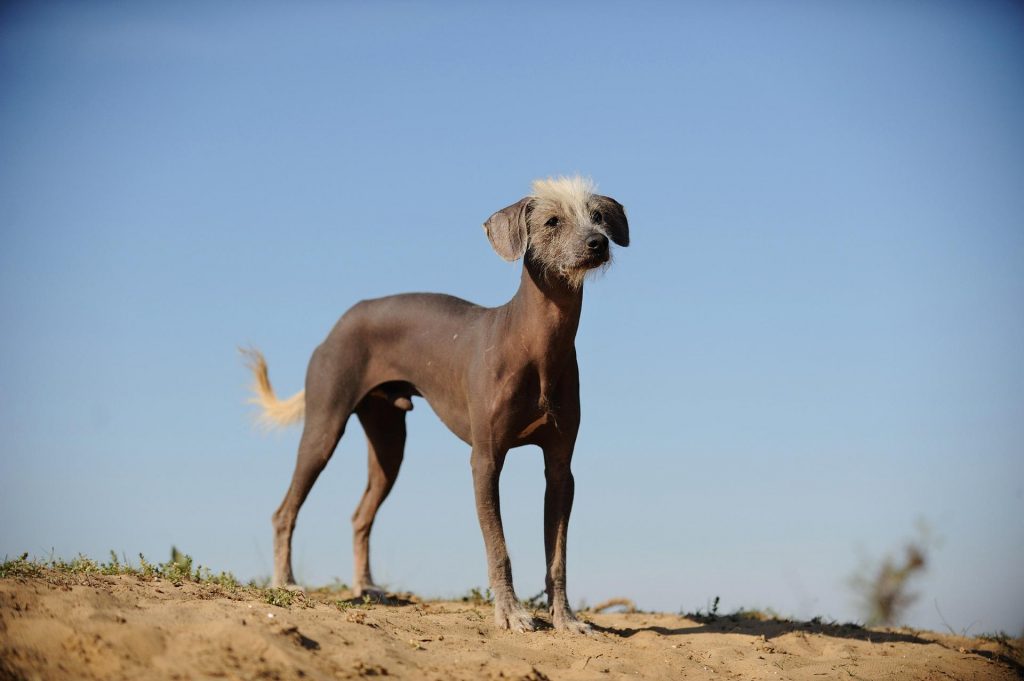
The first Peruvian dog was spotted by Spanish colonizers. These animals had been bred in Peru for hundreds of years before our era. The Peruvian Orchid of the Incas has two subspecies: the first one is bald, while the second one is covered in hair. According to the breed standard, the bald subspecies is to have little hair on top of their head, legs and the tip of their tail. The locals kept the bald ones as their pets and used the hairy ones for hunting. Nowadays, the naked Peruvian dog, as it is called in their homeland, is a rare sight in Peru.

Outwardly, this hairless dog resembles a little deer. It’s so rare that Peruvians consider it a national treasure. The Incas believed that dogs could cure a stomach ache and relieve the symptoms of some incurable diseases, such as asthma.

Apart from the lack of hair, the naked Peruvian dog has some other unusual characteristics. For example, the Inca orchid doesn’t sweat with their tongue but with their body. It is a nocturnal animal that becomes active in the late afternoon and stays awake during the night.

3. Tibetan Mastiff


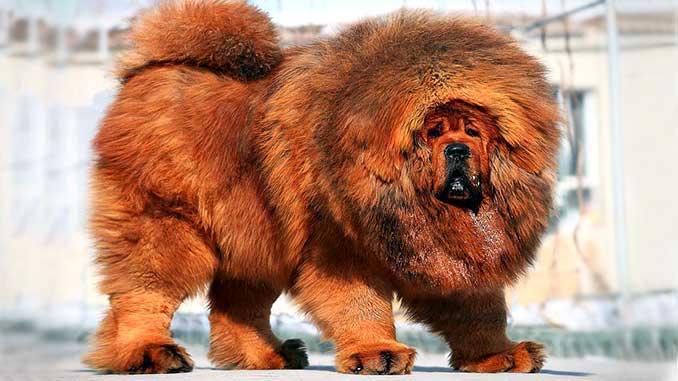
The Tibetan Mastiff is considered one of the first dogs to be bred by man. It was used to protect the herds and houses of the Tibetan people. The breed is independent, protective, and very loyal, which makes it an excellent guard dog. This is an ancient breed of dogs and is presumed to be the ancestor of all Molosser dogs.

Tibetan mastiffs have lived with humans for several centuries and learned to understand them really well. They are not aggressive and require no round-the-clock care and attention. You should consider getting one if you need a patient, loving and understanding friend.

Initially, Tibetan mastiffs inhabited the northern slopes of the Himalayan mountains. Hence, their name and increased endurance. They are really unpretentious and can become their owner’s fearless and devoted protectors.

Important facts about the Tibetian Mastiff:

  • Be careful – your cute teddy bear can have an adult weight of 45 – 75 kg. The size of the dog makes it unsuitable for living in a city apartment.
  • Tibetan mastiffs are usually active in the morning and evening. If your schedule does not allow you to walk with them at this time – this breed is not for you.
  • Tibetan mastiffs are very intelligent, independent and stubborn; they are also very sensitive to changes in their owner’s mood.
  • Tibetan Mastiffs need early socialization.
  • This breed is not recommended for inexperienced owners. The Tibetan Mastiff needs a confident coach who is consistent, firm, and loving.
  • Not recommended for families with small children.

4. Bergamasco Shepherd


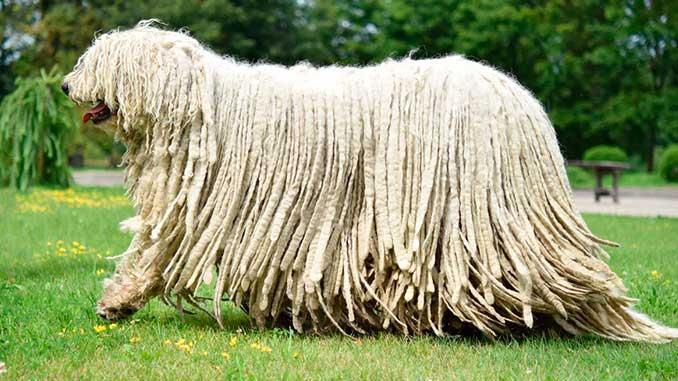
The Bergamasco is an ancient breed of dog, of which origin very little is known. Experts believe that their ancestors were mastiff-like dogs that accompanied the nomads coming from the East. Whatever the case may be, the Italian city of Bergamo in Lombardy is now considered a birthplace of these big and shaggy animals. It was there that these dogs began to be bred for shepherds in mountainous areas.

You cannot confuse the Bergamasco with any other dog breed. They may look scary but they are actually very good-natured and obedient. Bergamasco dogs grow attached to all members of their family but are particularly fond of children and their owners whom they consider their leaders.

The Bergamasco has well-developed protective instincts. If you are looking for a guard dog, this will be your safe bet. Yes, it can hardly be compared with the Caucasian Shepherd or any another service dog, but it is perfect for the role of a universal pet. The dog does not need to be put on a chain – it will be quite happy living in a private house and going outside now and then.

Like other shepherd dogs, the Bergamo is perfectly trainable. Of course, sometimes it may be stubborn, but it can be easily fixed. In fact, it is all a matter of finding the right approach.

5. Bedlington Terrier


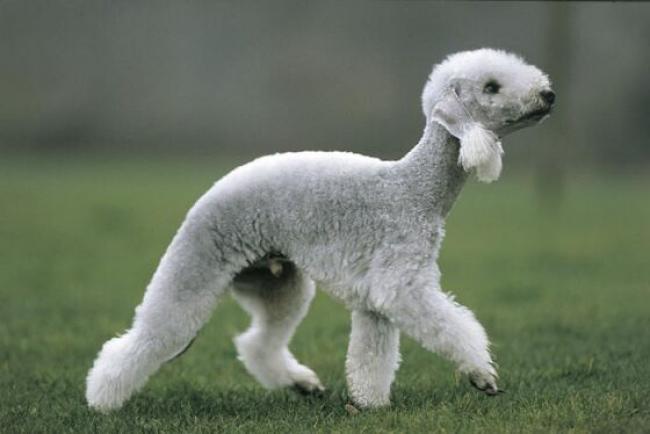
This dog breed originated in Great Britain. Being a cross between the Bedlington terrier, dandy-dinmont terrier, and otterhound, the Bedlington was originally meant to be a hunting dog. However, English gypsies also used it for dog fights and pickpocketing. Later on, the efforts of its breeders resulted in it getting the graceful forms everyone loves so much. The first official club of Bedlington lovers was founded in 1873.

The dog is common in America, Canada, Europe, Australia, South Africa, and Russia. Outwardly, this elegant animal looks like a neatly trimmed sheep.

Important facts about Bedlington:

  • The Bedlington can be hard to train
  • Early socialization with other pets is a must to prevent problems
  • Bedlington Terriers need training or else they will be bored and cause trouble
  • Males can be fierce fighters if they are challenged by another dog
  • Bedlingtons are very intelligent and fairly easy to train
  • Bedlington terriers love digging holes
  • You’ll need a fenced yard because they run very fast.

How To Keep Your Home Safe From Snakes

Keep Your Home Safe From Snakes

You don’t need to be a rocket scientist to know how deadly snake bites are. A single bite from a venomous snake can produce an array of symptoms that can include pain and swelling, nausea, convulsions, paralysis, and even death. This is one of the reasons why, as a homeowner, you should look for ways to keep your home safe from any kind of snakes.

Aside from using the best snake repellent, you should exert time and effort to keep snakes away from your home. Here’s how you can do it:

1. Regularly Maintain Your Yard

Maintaining your yard regularly is essential for keeping it safe, functional, and visually appealing. A well-maintained yard can increase the curb appeal and value of your property, and it encourages outdoor activities for the whole family. However, a neglected yard can become a breeding ground for pests and even pose safety risks, such as attracting snakes.

To prevent this, take the time to keep your yard in good condition. One effective tool for this task is an electric chainsaw, which can make trimming overgrown branches and cutting through thick vegetation much easier. Regularly using an electric chainsaw to manage large shrubs and trees can help maintain a tidy appearance and reduce the likelihood of pests taking up residence.

In addition to using an electric chainsaw, here are a few other tips to keep your yard in top shape:

  • Remove weeds, excess vegetation, and debris regularly. If you find this task overwhelming, consider hiring professionals to help.
  • Depending on the size of your yard, mow it at least once every two weeks. This not only deters snakes but also keeps other pests like mice and rodents at bay.

2. Eliminate Their Food Supply

Just like human beings, snakes have to be well-fed in order to live. If you want to live in a snake-free home, start by eliminating their food supply. Snakes will look for another environment or habitat once they see that your home doesn’t have any insects and rodents living in it. To achieve this goal, buy a pest repellent or make one on your own. The internet can be a goldmine of information for DIY repellants. Regardless of the route you’re planning to take, make sure that these repellents are used in areas where rodents are commonly seen.

You should also avoid using nest boxes, bird seeds, and baths as these can attract pests and rodents to your home. If there are trees in your yard, make sure that any nuts or fruits are cleaned and don’t remain on the ground for a long period.

If you’re planning to compost within your property, store it in a sealed container to keep snakes away. You want this compost to improve the quality of your soil and plants, not become a bait for snakes to live and multiply in your home.

3. Inspect For Crevices Around Your Home And Make Sure To Seal These Properly

Crevices serve as the entryways of snakes into your home. Even if you have a small crack on the wall, snakes can chew on the material and make the hole bigger. Once this happens, it’ll be easier for snakes to enter your home, damage your property, and even harm your family.

To steer away from this direction, walk through your home and check if there are any crevices. If you see any, properly seal all of these openings from both in and outside of the house. You can do this by patching all the crevices with caulk. You should also do the same for any gaps in your door frames and around the windows. To prevent snakes from entering your home, it’s crucial to seal any potential entry points. Inspect your home’s exterior for gaps or cracks, especially around windows and doors, and seal them appropriately. Engaging a professional window installation service can ensure that your windows are properly fitted and sealed, eliminating gaps that might allow snakes to enter. Additionally, installing door sweeps and weather stripping can help seal gaps under doors, further reducing the chances of snakes finding their way inside.

4. Consider Getting A Pet

Different people have different reasons for getting a pet. While some do this for companionship, others get pets in order to teach their kids to be responsible. But aside from these, are you aware that some domestic pets are snake deterrents? Chickens, ducks, and geese will naturally hunt snakes in your property and eliminate them. Furry friends, such as cats and dogs, can also do the same.

Consistency Is Key

You can only keep snakes out of your property if you’re consistent with your efforts. Implementing different practices for a couple of days won’t guarantee positive results. The efforts of keeping your home safe from snakes should be observed all the time, to the point where these become second nature to all of your family members.

3 Essential Nutrients Your Dog Needs Every day

nutrients for dog

Getting your dog’s nutrition right is critical. It is the difference between a happy and healthy life or one riddled with constant visits to the vet’s office. When asked what they feed their dog, most pet owners rapidly reel out water, lots of meat, and dry food.

Water, meat or proteins and dry food are great, but by themselves are never enough. While they perform some important roles – such as lubricating the muscles, build and maintain the body tissue – your furry friend needs more than three daily meals made up of protein and carbohydrate to be healthy.

Just as humans need vitamins because of the body’s inability to produce them, so it is with dogs. These micro-nutrients support your dog’s growth, energy metabolism, and fetal development.

Some commercial dog food diets usually come loaded with such vitamins. However, it’s important that you know what to look out for when shopping for food or supplements. Bring home the following three essential nutrients for your dog.

1) Vitamins

Your dog’s vitamins can mostly be found occurring naturally in food. As an organic compound, these silver bullets are necessary to sustain life. Some of the most important vitamins your dog will need are Vitamin A, B, C, D, E, and K.

They can usually be found in:

  • Eggs
  • Beef
  • Cottage cheese
  • Sweet potatoes
  • Fish

These vitamins boost your dog’s immunity, strengthen its bones and teeth, and also act as powerful antioxidants – supporting the reduction of inflammation and cognitive aging.

As your dog gets older, these vitamins assume a more important role in their diets, especially Vitamin C and K. These two vitamins prevent muscle degeneration and senility.

2) Digestive Enzymes

Dogs usually produce most of the digestive enzymes (proteases, lipases, and amylases) needed to digest food. However, as your furry friend gets older, supplementing their meals with digestive enzymes may be helpful. These digestive enzyme supplements also help with food allergies and intolerances, which also become more commonplace as dog’s age.

Digestive enzymes are usually an essential element of some of the best probiotics for dogs on the market. You can also get straight doses of digestive enzymes that you can mix with your dog’s dry food or wet meal.

They support a balanced gut function and strong immune systems. Digestive enzymes have also been anecdotally said to reduce or stop dogs from eating their stool. This is possible as digestive enzymes help your dog digest food properly, which then makes the stool smell less appealing.

Minerals

Minerals are the last piece of the puzzle in the hunt for a balanced dog diet. They can be divided into macro-minerals and micro-minerals:

  • Macro-minerals are minerals your dog needs in large amounts
  • Micro-minerals or trace minerals are needed in smaller amounts

There are 7 macro-nutrients essential to a dog’s health:

  • Phosphorus
  • Chloride
  • Magnesium
  • Sodium
  • Sulfur
  • Potassium
  • Calcium

Although you only have to bother about Iron, Zinc, Selenium, and Copper, there are at least 11 trace minerals in most mineral supplements.

A key difference between minerals and vitamins is when taken in excess, minerals such as calcium can cause bone deformities, fractures, and weakness.

Notwithstanding, minerals play an important role in maintaining an acid-base balance, the formation of red blood cells, healing of wounds or skin abrasions, and blood coagulation.

Bottom Line

Not every pet owner is raised to believe that vitamin, mineral, and digestive enzyme intake are as important for a dog as our own health. However, these three essential nutrients can completely improve how your pet looks and feels. Talk to your vet about a nutrient plan for your dog that includes dosage.

Why Is The Mini Bernedoodle You Potential Companion?

Mini Bernedoodles

Did you ever hear about the Mini Bernedoodle until today? Do you know what kind of dog this is? Would you consider it as an option when it comes to finding your ideal companion? If this breed sounds new to you, do take a few minutes to find out more about it. We found it more than interesting and, if you ask us, the Mini Bernedoodle has very good chances of becoming one of the most appreciated companionship dogs out there. Why you may ask? Well, here is everything you need to know.

A very interesting combination

Now, you’re probably wondering what is a Mini Bernedoodle and how did it appear. To start with, it is worth mentioning that crossbreeding two dog breeds gained a lot of traction lately. Dog breeders and dog enthusiasts are taking two pure, official dog breeds with the purpose of obtaining pups that present traits from both breeds. The main idea is to come up with dogs that have the best of both breeds.

The same happened in the case of the Mini Bernedoodle. The Bernese Mountain Dog and the Poodle were the two breeds used for the creation of the Mini Bernedoodle. Both of the breeds are known for their gentle nature, native intelligence, and loving character. So, it is normal to want to bring all of these in one single dog. So, it is worth looking for Mini Bernedoodle puppies for sale because you will gain an incredible dog at your side.

If you’re considering adding a Mini Bernedoodle to your family, finding a responsible breeder is key to ensuring a happy, healthy companion. For example, Mountain View Bernedoodles at mountainviewbernedoodles.com is a trusted source for high-quality Mini Bernedoodles, known for their careful breeding practices and commitment to the well-being of their dogs. They provide detailed health screenings, early socialization, and ongoing support for new owners—making the transition into pet parenthood as smooth as possible.

The result can be quite a surprise

If you love surprises, you will certainly love the Mini Bernedoodle. Because there are considerable size differences between the dog breeds that were used for the creation of this dog, a Mini Bernedoodle can have a final weight ranging anywhere between 20 and 100 pounds. It depends very much on how many genes it gets from one parent, in comparison with the other. If it inherits more from the Bernese, it will grow slightly larger. If it inherits more from the Poodle, it will grow to be a smaller dog.

But, no matter how large or small it will turn out to be, this dog will love being around people. The Minie Bernedoodle is an extremely sociable dog, highly affectionate toward its owner and family, and ready to please. At the same time, it is not as fragile as small dog breeds are, so you can be sure that outdoor trips and adventures will not cause any troubles.

How do they look?

It may be hard to picture how a combination between a Bernese and Poodle looks like, but you will be surprised to notice that the resulting dog is quite cute and cuddly. If the Bernese dog has a tricolor coat, the Poodle is more colorful, being available in a wide range of colors. So, how can a Mini Bernedoodle puppy look like?

Bernedoodles can inherit all the available colors of their parents

If you are a person that loves having a wide range of options to choose from, you will be able to do so if you’re looking for a Bernedoodle puppy. Their coat, which is curly, soft, and dense, is available in very many colors. Whether you like a dog in one single color or you’d enjoy one with a more colorful coat, you will have everything you need with this designer breed.

Also, besides the generous color palette, it is interesting to see that the degree of curliness the coat of the Bernedoodle can get is variable as well. In other words, some dogs may feature a curlier coat than others, which may display a coat that is wavy instead of curly. There are chances that you won’t find such diversity within any other crossbreed. The most interesting part is that you can find diversity even within one single litter of pups, as they can be very different in terms of aspect.

The Temperament of Mini Bernedoodles

One thing is for sure about the Mini Bernedoodle and that is the fact that these dogs are extremely intelligent. They have are very smart, which makes them easy to train and highly intuitive. This is because both the Bernese dog and the Poodle have these traits. In spite of their obvious physical differences, the parents of the Bernedoodle share a rather similar temperament and personality.

So, even if you don’t have too much experience in training and educating dogs, you won’t have too much trouble with the Bernedoodle. These dogs learn fast and are great for agility courses as well because they display an athletic physical shape. They are calm and loyal and entirely devoted to their owners and family. Although, when it comes to strangers, they are wary and don’t tend to trust anyone too quickly. Of course, they are not aggressive dogs, but it is recommended to start socializing your puppy as soon as possible. In case you are in search of a dog that can be calm yet outgoing, with a cuddly look but without being sensitive and fragile, you will have all of these in the Mini Bernedoodle. If you can get over the fact that you can’t know for sure just how large your puppy will get, this crossbreed can be the loyal and loving co

Choosing an Exotic Pet Veterinarian: Tips and FAQs

Choosing an Exotic Pet Veterinarian

When it comes to pet health, one common misconception is that veterinarians are schooled to care for any species of animal that comes their way.

In reality, most Doctors of Veterinary Medicine (DVMs) that can be found online specialize in common domestic pets, not exotic species. As such, you will need to consult a specialized vet for animals such as rabbits, amphibians, reptiles, birds, and even fish. You might also want to check your financial situation and the exact costs involved with owning an exotic pet. You might be surprised to learn that the associated costs of owning an exotic pet can reach thousands of dollars, if not more. You better budget the expenses before going into this, just get a free budget template, consult with Pet store owners and find out the exact costs of keeping your dream pet.

Here’s what you need to know about choosing the right medical expert for your special companion.

What is an exotic veterinarian?

In a typical School of Veterinary Medicine, veterinary practitioners-in-training are taught a streamlined, generalized curriculum that addresses core concepts of animal health.

Technically, any board-certified veterinarian can treat exotic pets as long as it is legal to own the animal in question, but finding a local vet to do so can be a challenge. Once a vet has obtained their Doctor of Veterinary Medicine (DVM) degree, there are schools that offer additional training and licensing in Zoological specialties beyond the sphere of traditional domestic pets.

Vets who choose to specialize in exotic pets are usually accredited to associations that bring them on as members such as the Association for Avian Veterinarians, the Association of Exotic Mammal Veterinarian, or the Association of Reptile and Amphibian Veterinarians. 

When to consult an exotic vet

Trial and error is usually the experience that exotic pet owners face when their pet becomes ill. It can be difficult to find a specialist that is within a reasonable distance.

The first line of practice should be to consult veterinarians in your area and inquire if they are willing to treat your pet — there is a remote possibility that a number of them will be willing to try. If you have no luck, ask local vets if they have a referral to an exotics vet. If not, the organizations named above will provide you a member directory of exotic vets with their contact information.

As previously mentioned, depending on the type of exotic pet you may be able to find a local vet who has experience treating these species. Birds, small mammals such as rabbits, and even some domesticated reptiles may have come across a local veterinarians’ exam table — experience gained is an experience given.

If you do find a local vet willing to examine your exotic pet, always enquire about the DVM’s experience with the animal and make a sound judgment call:

  • Always inquire about adequate equipment applicative to your animal. Exotic pets can range from the smallest to the largest of species, so you will want to make sure that your selected vet has the equipment to examine animals of varying weight and size.
  • Be sure and inquire about your vet’s comfort and ease in handling exotic pets, as these animals can be much more difficult to restrain and make calm in comparison to everyday domestic pets.
  • Ask if the vet has any continuing education or board certification in a nationally recognized association for exotic species.

That last point is the most important. Veterinarians who wish to specialize in exotic animals usually choose to continue their education with one of these institutions and if so, these doctors are your best bet when choosing an exotic vet. As an additional benefit, DVM’s with board-certified credentials will most likely have after night care available for your exotic pet. 

For large and dangerous types of exotic pets, you will want to consult veterinarians who have training with those specific species. Although local inquiries should always be your first search — especially in an emergency, it can become increasingly difficult to find a vet willing to take these cases. A search of national associations for the particular species will provide you with the comprehensive results.

The bottom line

Exotic veterinarians have no one area of training when obtaining their Doctor of Veterinary Medicine degree. It requires additional training and board certification for a vet to be recognized as an exotic vet. 

Since there are some general vets who may have minor experience in treating some exotic species, it never hurts to do a localized search to check for experience with your animal. The best bet for finding an exotic vet is to consult the nationally accredited associations whose board-certified members are comprehensively trained to address health concerns of exotic pets.

Home Remedies That Can Help You to Get Rid of Snakes

Get Rid of Snakes

Of all the wild animals, snakes are usually among the most feared ones. This is simply because of their aggressive nature and the damage they can cause when they attack. We all know that snakes are quite dangerous animals and we’ve seen what they are capable of on several occasions launching vicious attacks on both humans and other animals.

During the cold seasons, these creatures will often be looking for warm places and your house can provide a very good hiding place for them. Snakes will also enter your house if you provide shelter for rodents since they are known to be snake’s delicacy.

If you are tired of reptiles entering your home and are looking for ways in which you can prevent them from entering your property, you should consider trying some of these simple home remedies to help you out. See this for more information.

  • Clove oil and cinnamon oil

Instead of using any fancy methods, you can simply use homemade snake repellents. I mean, if you can make your own repellents there’s really no need to spend much money trying to find an effective repellent, right?

Anyway, if you are looking to keep away the reptiles from your home, you can use Clove oil and cinnamon oil as they can make very good snake repellents. These products have been reported by the wildlife to have great effects when it comes to keeping the snakes away from your home.

However, when you will be spraying the oil, you should be much careful since you are not supposed to spray the oil directly to the snake. This is quite dangerous as the snake might shift in your direction and launch an attack towards you.

You can also use both the Clove and cinnamon oil as fumigators. You only need to pour some oil on a piece of cloth and then use a paint stripper gun to volatize it with some heated air. This will make sure that no snake makes it to your home by providing an unpleasant smell that will keep them away.

  • Powdered Sulphur

Well, even though you are trying to come up with solutions on how you can get rid of snakes, you need to watch the kind of materials you will be using. This is because your health is also very important and therefore using a non-toxic remedy like powdered Sulphur is a good advantage.

However, even at this, you will still need to put on a protective gear that can properly cover both your nose and mouth. This is to keep you from inhaling the bad smell that is often produced by the powdered Sulphur. Using this remedy is quite easy since you only need to sprinkle the powder to areas that are likely to provide a hiding place for snakes.

This includes your backyard and those tiny cracks on the walls of your home. The effectiveness of this simple home remedy is usually credited to the mothballs found in the Sulphur powder. Using mothballs can, however, be quite dangerous since they are much toxic and can lead to various health complications when not used in a good way. This is why it is important to be extra careful when using this remedy with children or pets around.

  • Cut the food supply

Among the tactics you can use to defeat your enemy, cutting their food supply is always an effective method. As it is with every animal, they will always try to establish their dynasties near their food source.

This is why you will most definitely have an upper hand when you manage to cut their food supply. For instance, snakes always pray on rodents and insects which can easily be found in your home thus attracting the reptiles.

You can use various methods to deal with the rodents and insects as keeping them away will also mean not having any snakes to deal with. This comes as a double advantage since you will also be freeing your home from the moles, mice or rats as they can also cause other serious damages besides attracting the snakes.

  • Gardening

One of the ways in which you can have an attractive yard to improve your home décor is simply by gardening, right? Well, it turns out that not only do gardens improve the appearance of your home, they can also help by keeping snakes away from your home.

Anyway, since you have the ability to control everything in your garden, you can just decide to make it uncomfortable for the snakes. Of course, you don’t expect them to stay in an environment that is hostile or harsh to them, right? They will probably move or just stay away from the place.

By keeping your garden uncomfortable, you don’t have to leave it unattended. On the contrary, you will need to be working on it quite often. You need to ensure that the grass in your yard is always short and that the yard is always clean without too much debris around.

You can even use a mesh fence to provide security from the snakes and prevent them from entering your house. Well, for those who don’t fancy a grassy backyard, you can go ahead and have a graveled one. This will completely keep the snakes of your yard.

  • Onion or Garlic

For those of us who like cooking, onions and garlic are among the most commonly used ingredients in the kitchen. Well, it seems like they do more than just flavoring our foods as they can be used for keeping away the snakes.

Do you know that thing in onions that always make you cry when chopping them? Yes, the sulfenic. For an animal with a great sense of smell or taste like snakes, this is quite unbearable and therefore can keep them away easily.

You can mix rock salt together with garlic and just sprinkle the mixture around in areas where snakes are most likely to be and let it do its magic. You can also use garlic oil as a fumigator and try to reach those tough places where you might be suspecting a snake to live in thus driving them away.

Snakes are very dangerous animals and keeping them away from your area of residence is always a good move. If you have no idea how you can do that, you go ahead and use these simple tips to get you started. For more tips you can check this out.

How to Take Care of a Labrador Retriever puppy

Labrador Retriever puppy

The Labrador Retriever is one of the most popular dog breeds in the world. And why shouldn’t it be! This breed is famous for being a fun-loving, family favorite.

But many dog lovers may go out to choose their Labrador Retriever puppy thinking it will be so easy to look after. It ain’t always that simple!

We are going to run down the best advice for successfully caring for a Labrador puppy so you have the best and happiest dog in the world.

Two Key Tips for a first time Labrador Retriever owner

First of all You have to judge your lifestyle, and whether it works well to match the requirements of a Labrador Retriever puppy, especially if you work away from home all day. Any puppy requires a lot of your time and effort, so make sure you are able to handle this before you choose to get one.

A Forgotten Fact – choosing the RIGHT puppy. Not just the right breed, but the right puppy from that breed. If you choose from a good source, ie a responsible Labrador Retriever breeder – they will tell you the personality of each puppy in the litter. This is possible for a breeder to see from around 8 weeks of age.

Labrador Retriever For example, if you choose the liveliest then you are likely to have the hardest work to control mischief. But if you choose the quietest it may not be the best for a family dog. So make sure you fit the personality of the puppy to your lifestyle.
But all in all, the Labrador Retriever is a good breed for a novice dog owner, you just need to plan ahead…

Just Before your Labrador Puppy’s Arrival

What you need to prepare for mentally

The arrival of your Labrador puppy means your life will be disrupted, immediately, and dramatically. That may sound brutal, but it is true. You might be lucky and have a very smooth start with your puppy, but whatever the process, you need to be ready to tackle challenges, disruption and drama! So be prepared to get out of your comfort zone.

What you need to do beforehand

You need a supply of food, toys, and equipment prepared. A bed, collar, lead, dog brush for grooming, and crate would be a minimum to have before your puppy arrives. Well, who knows after having a pet in your house, you get so acquainted with pets that it may change your future. (read more about pet grooming career information)

Puppy proof your home. Cover up cables, and hideaway small or harmful objects so they are out of your curious puppy’s reach.

Your Labrador Puppy’s First Day at Home

The first day should be all about easing into your home.

If you have chosen a puppy from a breeder, then it is likely the puppy is used to just one place so far, and a new area can be scary at first.

Everything on that first day should be done in a surround of calmness, unless your Labrador puppy is already super excited, then you can go with the flow.

Otherwise, you should give the puppy time and space to gently explore your home and garden. According to the experts at Grooming Scissors Direct, If the puppy is shy, then just leave them be at first, and let them come to you. Some are happy right away, some may take some days to ease in. There is no normal way for it to happen, so don’t worry.

Your Labrador Puppy’s First Month at Home

The two key words are SOCIALIZING and TRAINING. This is true for any breed, and luckily it is usually very easy for a Labrador puppy, especially the socializing.

After the first few days in your home, you should begin to focus on socialization.

What is socialization?

It is introducing your puppy to new people, places and dogs, so that they can grow to be neither timid or aggressive.

It is key in this early, impressionable age to get a puppy used to the world around them as soon as possible. Introducing them gently to new people, both in your home, and outside, will help them to accept people, and not be afraid. The same with other dogs and places, carefully going to new areas, both busier and quiet, and meeting calm, friendly dogs, will help your Labrador puppy adapt very quick.

What about the training?

A Labrador puppy is an overexcited, bundle of fun, but training has to be tackled so they can learn their place in the world, that you are in charge, and knowing right from wrong.

Positive training is always the best route, when learning commands, teaching them potty training or walking on the leash. Praise positive behavior, and ignore your Labrador puppy when they do wrong. And be persistent, as it can take time.

Keeping your Labrador Puppy Happy, Healthy and Handsome

Top Tips for Caring for a Labrador Retriever Puppy up until 18 months old

Feeding – 2-3 times a day. Portions that are smaller and more frequent are better than fewer and bigger. Check out our post about tips to feed your pets.

Exercising – Moderate length walks, a little swimming, and playtime in small doses is best while pups bones are growing.

Grooming – They only have moderate grooming needs, and if they need a wash, take your pup for a swim, they will love it!

Health care – If you choose from a good breeder, your pup will always be vaccinated up to date. But regular checks and boosters are needed, especially in the first year.

Love – Most of all your Labrador will require lots of love from you. As much time as possible by your side, playing, cuddling and stroking is the best thing a Labrador puppy can get from you!

All this info may make caring for a Labrador Retriever puppy seem like a challenge, and yes, sometimes it can be. But with some preparedness in advance, it can be a lot of fun too, and a good start to life with you can help your Labrador settle in and become the best of furry friends.


4 Innovative Ways to Feed Your Pets

ways to feed your pets

We only want the best for our pets, be they scaly, fuzzy, furry, or fluffy. With busy schedules it can be tough to be there for them every time they need us, and sometimes their toys, food, and routine can become just plain boring.

Year after year new research emerges and as a result new pet care inventions are put on the market. You might not be aware of how much fun you and your pet can have during feeding time with some of these cool new products available.

We all know now about “automatic” water dishes, which fill your dish after the water drops below a certain level, but what about automatic feeders? Or other engaging methods of feeding your animals so it isn’t a mindless task?

Here are just a few fun or innovative ways to make sure your pets get the nutrition they need, whether you are home or not.

1.     Automatic Cat Feeder

Many pet owners know about automatic dry food feeders, but what about automatic wet food feeders? Most felines need a good balance of solid and wet food for a good diet and to receive the right nutrients. When you work long hours, it might be difficult to keep them on a consistent schedule of wet and dry food.

However, the good news is that an automatic cat feeder for wet food does exist, and it can make the life of a cat owner so much easier. You won’t have to worry about that feeding schedule again!

2.     Puzzle Feeders for Dogs

Like children, dogs need lots of stimulation and engaging activities to keep them entertained and to help them learn. Instead of putting your dog’s meals in a boring old bowl, consider getting an interactive or puzzle feeder, which challenges your dog just a little bit more in order to find their food.

It sounds like it might be unfair, but these puzzle feeders are not as complicated as they sound. Many are simply in the shape of a maze, and some are made of soft rubber in different shapes and textures to engage the dog’s curiosity. It’s a great way to entertain and feed your dog all at once!

3.     Make it a Hunt for Snakes

Snakes get most of their exercise in their natural habitats during hunting. For snakes in terrariums at home, no matter how large or small the tank or the snake, simply dropping their food into the cage can lead to a number of things – a hunger strike from the snake, the snake getting obese, or misleading signs of aggression.

A way to engage your snake and prevent these other possibilities is deceptively simple – experts have said to make your reptile hunt.

If your terrarium has a lot of décor, try hiding the prey in a difficult (but not impossible) spot. Prior to placement, rub the mouse (or whatever food) around the tank to create a trail for your snake to follow. This will simulate a hunt and give your snake some exercise too!

4.     Food Ball for Bunnies

If you have a rabbit, you know how energetic they can be. Many companies have started creating food balls, which encourage rabbits to put in a little extra effort to get their food. These toy-feeder combos enrich your bunny’s life by providing them with an engaging activity and food at the same time. The toys are relatively simple and highly affordable, and make for a great addition to a bunny’s life.

Feeding Your Pet Just Got A Lot More Fun

There are so many ways to make mealtime more fun for your pets, whether it be toys or presenting a challenge. Feeding methods change depending on the species, so sometimes you just have to get creative when the routine becomes boring.