
Home Blog Page 18

How Do Snakes Poop? And The Secrets Behind It

I know it’s not the most pleasant question or topic to discuss before lunch or dinner, but poop is a major part of our life on earth. We humans usually poop at least once a day, while birds might poop tiny bits 40-50 times a day. Snakes, like any other living organism, poop regularly. However, in contrast to humans and birds, snakes don’t poop that often at all. Some researchers even claim that snakes are among the least pooping animals on our planet.

According to a research published in the book “Biology of the Vipers” – snakes can go on without pooping for amazingly long periods of over a YEAR. That’s definitely amazing, and truthfully – a bit scary to think about as a human, but it has nothing to do with constipation. The snake poop biology has practically evolved over millions of years, in order to increase its survival chances. How exactly? We’ll answer that shortly, but first let’s understand the technical aspect of “How do Snakes poop?”.

The Technical Aspects of Snake Poop Biology

Very similarly to bird poop, snake poop is comprised of two major components: The fecal fragment (the poop) and the uric acid fragment (the snake urine). Snakes expel this poop through their anal scale that is called “Cloaca”, which also marks the end of their belly and the beginning of their tail. The Cloaca is the only opening that serves the intestinal, urinary and genital tract. Snakes also mate and lay their eggs through the Cloaca.

How does the Snake Poop Biology Help It Survive?

Well, as you probably already know – snakes hunt prey that is usually much bigger than themselves, and they eat it whole, be it a big rat or a huge deer. The fascinating snake diet means that after a deer-meal, the snake will triple (or more) its body mass in just a few minutes. The snake will then begin to digest the deer from the outside in. According to Matthias Starck, a zoologist at the University of Jena, “Snakes develop their digestive organs into extremely efficient functional units within a very short time and return them to their original state when they have done their job”. Snakes even rebuild other organs, including their hearts, which grow exponentially in size each time they eat.

By growing their organs only for digesting their meals and then instantly shrinking them back to their original size – snakes are actually saving lots of energy. This valuable energy saving technique is used by snakes to survive for long periods of time, when they can’t find no prey.

As you can see, answering the question of “How do snakes poop?” has already led us to some very interesting alleys, so let us continue…

Why do snakes poop so infrequently?

Well, it all boils down to food, and the snake diet. As we know, snakes don’t always find prey. It’s a game of luck for them, and snakes might eat very infrequently, sometimes only a few times a year. Once they do find prey, swallow it whole and digest it, it is then reduced to poop, and the amount of time it takes until it slips out depends on the snake species. For some snakes, like Rat-snakes, it will take about two days between eating and pooping. Other snake species like bush vipers will take between 3-7 days. However, the most fascinating species are heavy-bodied snakes like Boas and Pythons, whose poop can stay inside for months and even longer than a year. Researchers have shown in field tests that a Blood Python held its poop for 386 days, while a Gaboon Viper didn’t poop for 420 days.

Why do these snakes store their poop for so long?

Some scientists claim that snakes like Boas and Pythons store their poop in order to add extra weight to their bodies, giving them an extra advantage over potential prey when fighting, catching and subduing it. The poop is concentrated in the posterior of the snake body, which could be used as a leverage when the snake strikes a prey or constricts it.

These assumptions haven’t been proven yet and there are still a lot of questions out there regarding the Snake Poop. Problem is, I’m not sure that many scientists are thrilled to delve into it…:-)

What Does A Crocodile Eat?

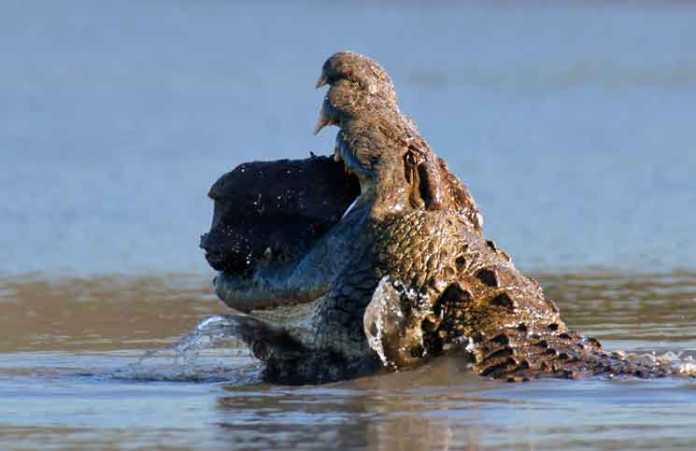
What does a crocodile eat
Nile Crocodile: Photo by Johan Swanepoel

The question should not be what does a crocodile eat. The question should instead be what a crocodile doesn’t eat. What crocodiles eat includes everything that is edible.

A crocodile can eat and does eat humans, from time to time. Crocodiles eat all kinds of reptiles, animals and birds as well as fish. Crocodiles are not that picky about their diets. When they are hungry, they will gorge on anything that is available to them, more specifically anything that moves or crawls, swims or flies. Crocodiles particularly like snakes, deer, fish, small elephants, cows, carrion, gazelles, wild boars, dogs, buffaloes, wildebeests and kangaroos among others. Crocodiles also attack and eat sharks. They also eat other crocodiles if there is such a need. Crocodiles will also not spare hippopotamuses and rhinoceroses. However, there haven’t been cases of crocodiles eating whales, so far. Possibly, the size of the latter acts as a deterrent, even for the largest crocodile, the Australian saltwater crocodile.

Crocodiles are among the most sturdy of all reptiles as well as mammals. They are very hard to kill and also quite difficult to capture. That has made them a hunter of all things living as well as dead. They do like to gorge on dead flesh as well.

Crocodile are unbelievably great hunters. This makes them quite efficient at getting what they want. They can jump up through river waters or from the sea level for quite a few feet, which allows them even to get some birds on the fly.

A crocodile can easily drag any small, medium or slightly large animal from land to water. The poor animal will then suffer a natural death due to drowning. Those that can swim also succumb to the weight and sharp teeth coupled with swift movements of the croc.

A crocodile is also extremely aggressive when something or someone trespasses their territory. They will attack immediately and shred or cut through a living being. Crocodiles are also known to have attacked, killed and consumed anacondas.

What does a Crocodile Eat: How about a Zebra? Watch this…


What crocodiles eat is however restricted to where a crocodile is living, what its abilities are and whether or not it is in captivity. A croc bred and raised in captivity may not be a great hunter and might have a certain dietary preference. A smaller croc which is just 3 or 4 feet in size will not attempt to attack a medium or large animal or even humans. Likewise, a crocodile in uninhabited regions will have to remain confined to whatever living organisms are available in its ecology.


How NOT To Fix The Tail Of A Lizard

lizard facts

Disclaimer: This Lizard Cartoon explicitly does NOT encourage anyone to try or do any of the actions performed in the drawing. Kindly view it as a Cartoon, which it is.

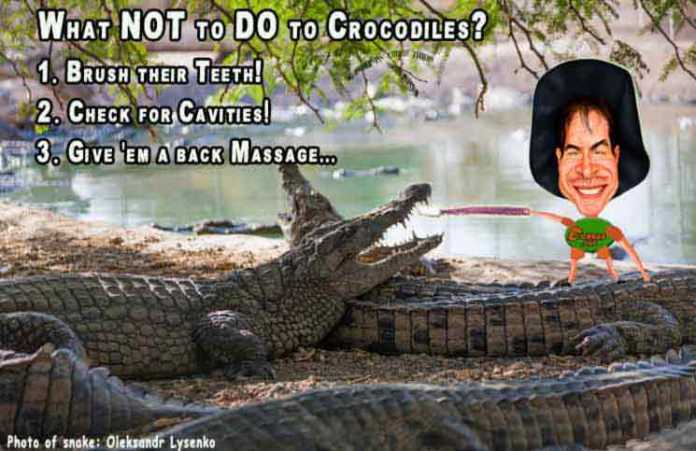
Cartoon: What NOT To Do When Meeting A Crocodile

Crocodiles

Disclaimer: This Crocodile Cartoon explicitly does NOT encourage anyone to try or do any of the actions performed in the drawing. Kindly view it as a Cartoon, which it is.

King Cobra Snake goes Social, becomes Viral

King Cobra snake
Runaway King Cobra goes Social!

Since breaking loose from his owner’s home in Orlando, the runaway King Cobra snake has become a nationwide phenomena. First, it made almost every news channel in the country, including CNN, Fox and BBC. Then, the King Cobra snake went social, and immediately became viral.

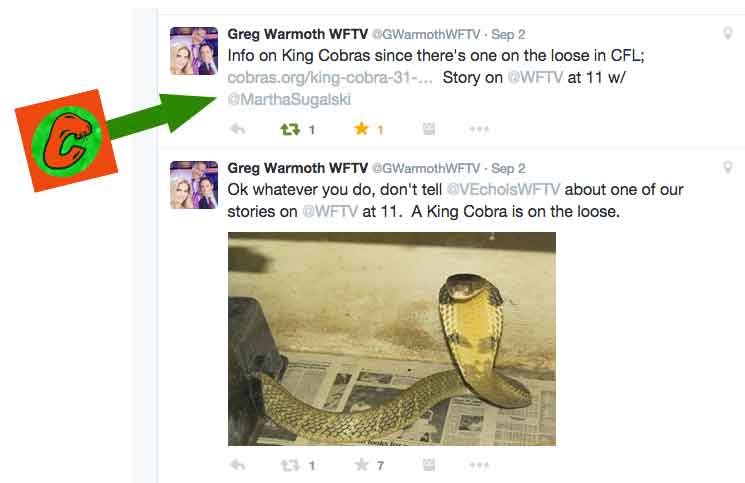
Hundreds of thousands of people started posting all sorts of posts and tweets about the King Cobra snake, some were funny and creative, some alarmed and terrified. We at Cobras.org even had the honor to feature on some TV Host’s Tweet.

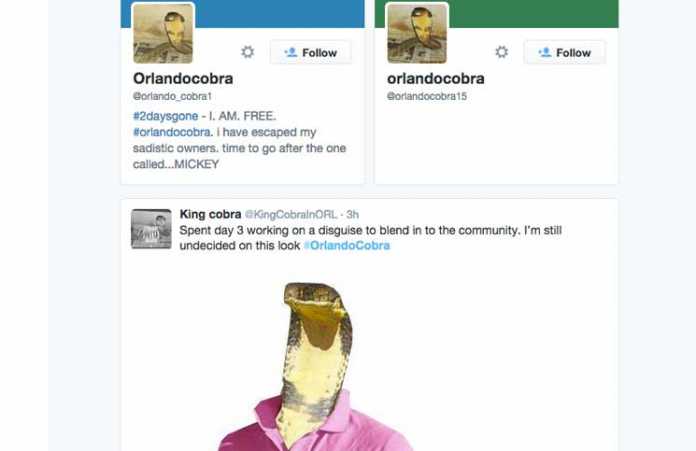
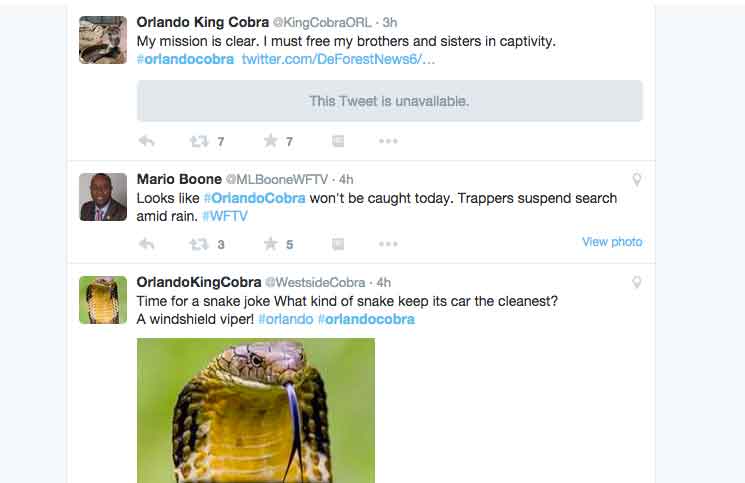
The funny and parodic tweets and posts were posted by new farce accounts that popped up during the last week, each claiming to be the runaway King Cobra, one of the deadliest snakes on the planet. Among theses you can find tweeter accounts @orlando_cobra1, @KingCobraORL, @orlandocobra15, and many others.

Spent day 3 working on a disguise to blend in the community…”, says one account with a matching hilarious picture of a Snake-Man, while another account just shouts out “I.AM.FREE”“. Some users amusingly pretending to be the Cobra snake even tried to make their personal statement through the runaway King Cobra: “My mission is clear. I must free my brothers and sisters in captivity. “ Others report of the great time the King Cobra is having in downtown Orlando, enjoying every moment of his freedom.

Law enforcement officers and many other snake handlers have been searching the dense wooded area for days, but until this very moment, officials have yet to catch the runaway King Cobra snake.

King Cobra snake
Find the funnies Tweet by King Cobra

Our bold guess, is that the runaway King Cobra hasn’t really “run” far. It’s probably just hiding somewhere close by to the home it escaped, but that can be any tiny hole, AND – the King Cobra could stay put in the deep for quite a while. Let’s hope no one confronts it aggressively, and no one gets hurt.

In case you do survive the ordeal, you can already purchase a cool T-shirt that’s out there, saying “I Survived the King Cobra Escape of 2015!”. 🙂


Snake Habitat: How far will a King Travel?

Last week, one of the deadliest snakes on the planet, a King Cobra, managed to escape from his owner’s home in Orlando. The story made it immediately to almost every news channel in the world, including CNN and BBC. As the No. 1 online resource on Cobras on the planet, our team here at Cobras.org had our hands full, answering inquiries from journalists and worried citizens. TV Anchor Greg Warmoth from WFTV Channel 9 (an ABC-affiliated TV station) even mentioned us on his Twitter account – as an Info resource (see below the screenshot of Greg Wamoth’s Twitter account).

How fast can it travel? How far can it travel? Where would it be hiding? These were most of the concerned questions we got from citizens who contacted us.

Well, unfortunately there is no data about the average speed of King Cobras. It is quite difficult to measure the speed of any snake in motion, since they never travel in straight lines when moving at their top speeds. As they move forward, in order to find traction on the ground, snakes move their bodies from one side to the other.

snake habitat
Screenshot of TV Anchor Greg Wamoth’s Twitter account: Mentioning Cobras.org

However, generally snakes can travel 3-5 miles an hour. We assume Cobras (King Cobra included) would be at the higher part of that range, probably with the ability to travel 5 miles an hour.

As to “Where a King Cobra will go?”, well, the King will always prefer humid locations over arid ones. Its most preferred habitats are dense or open forests in areas near streams or that provide access to bodies of water. If you go searching for one, try looking at bamboo thickets, agricultural areas, dense mangrove swamps and near the water’s edge, where the King will usually search for his prey.

Check out our post about the King Cobra Habitat.

How far and why do snakes travel?

Back to the main concern of the citizens of Orlando, who are still awaiting news as to where the King Cobra is – snakes will travel as far as they must for prey and shelter from weather, especially when it’s cold weather or extreme heat. As the winter season ends and the temperatures slowly rise, snakes will start to become more and more active. They begin by basking in the spring sun, but will not move far from their hibernating spot. As the spring days become warmer on a more consistent manner, the snakes will start to move further away from their hibernating spot, towards their summer habitat. The reasons for moving away are usually to find mates, locate foraging areas and to give birth.

When snakes reach their summer location, they will usually travel only for short distances. Exceptions are some male species that will travel practically anywhere in search of females, in order to mate. As Fall arrives, snakes will slowly start their travel back to their hibernation spots. Many species will return to the exact same location every year, while others will travel for weeks seeking out new habitats to spend their winter.

As we are writing this post, the Florida Fish and Wildlife officials are continuing their search for the mighty King Cobra.


King Cobra vs Python: The Ultimate Battle

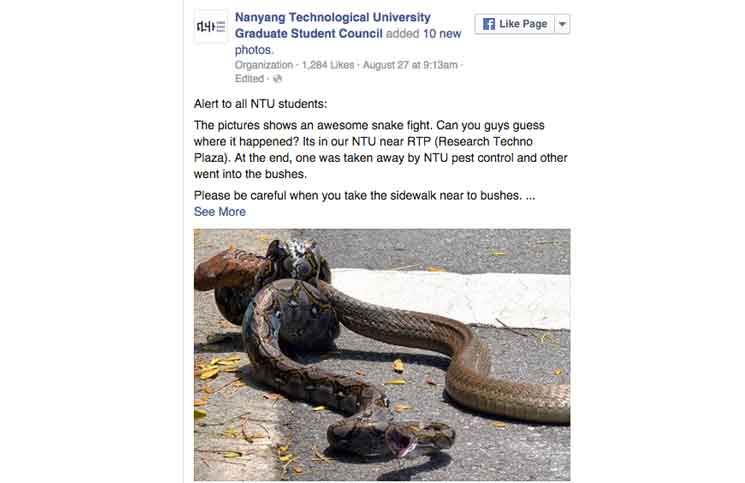
The ultimate snake fight, King Cobra vs Python, occurred last week at the most unlikely battle scene: A University campus in the richest and cleanest city-country in Asia, Singapore.

However, it seemed the two majestic snakes didn’t really care of the beautiful scenery, the terrified audience or the excited smartphone cameras.

The 12 feet King Cobra and the reticulated Python apparently made their way into the Nanyang Technological University campus from the dense jungle that surrounds the area.

They fought savagely on the polished streets of the Asian city for over 30 minutes.

At first, in the early seconds of the ultimate battle, it seemed as if the powerful Python had the upper hand. It managed to constrict the King Cobra and got it into an extremely deadly head lock.

King Cobra vs Python
Facebook Post from the Nanyang Technological University

However, the mighty King Cobra suddenly managed to escape back into the bushes, but not before it injected it’s deadly venom into the poor python.

The massive blow left the python motionless, as both snakes were later captured by the singaporean authorities.

Although the python was released back into the wild, its chances of survival are estimated to be very low.

The battle was extremely unique, not because of the python who is quite common in Singapore, but because of the King Cobra who is rarely seen in those areas, as it usually live deep inside the jungles.

Amazing: Chinese Cobra with Two Heads

A few days ago, on a quiet farm in southern China, a snake breeder by the name of Mr. Huang – discovered the most amazing baby Chinese Cobra you have ever seen. It’s something you’d expect to see on a mutant TV show or in a movie like X-Men, but this is for real. Mr. Huang discovered a Chinese Cobra with two heads! And the two heads are even fighting with each other, moving in opposite directions and even trying to swallow each other!

Similarly to siamese twins, both heads of this baby Chinese Cobra have two separate brains, what allows them to move independently. These types of mutant snakes usually do not survive for long. However, according to the latest update from China – the baby Chinese Cobra is still alive and growing and even changed its skin once, but – neither of the two heads have been eating or drinking.

The mind-boggling mutant Cobra, whose second head begins approximately three quarters up the snake’s body, has been handed over several days ago to the care of experts at the Nanning Zoo in Guanxi, China. Their mission is to make sure the venomous two-headed Chinese Cobra survives and lives longer. However, it’s quite a long shot, and as one of the zookeepers at Nanning Zoo already told the press, “there was no way of telling whether the Chinese cobra will survive”.

Watch a news-recap of the story:

The condition of having two heads, or more, is called Polycephaly, and is actually quite common among snakes. There are quite a lot of occurrences of multi-headed animals, both in reality and of course in mythology. For example, in Heraldry and Vexillology, the double-headed eagle is a revered symbol, although no such animal has ever known to existed.

When it comes to snakes, most polycephalic snakes tend to have a short lifespan of a few months, although there is a report of a two-headed Rat-snake that has lived for 20 years.

Let us hope and pray that the baby Chinese cobra gets at least the same…

Catching a Taipan Snake

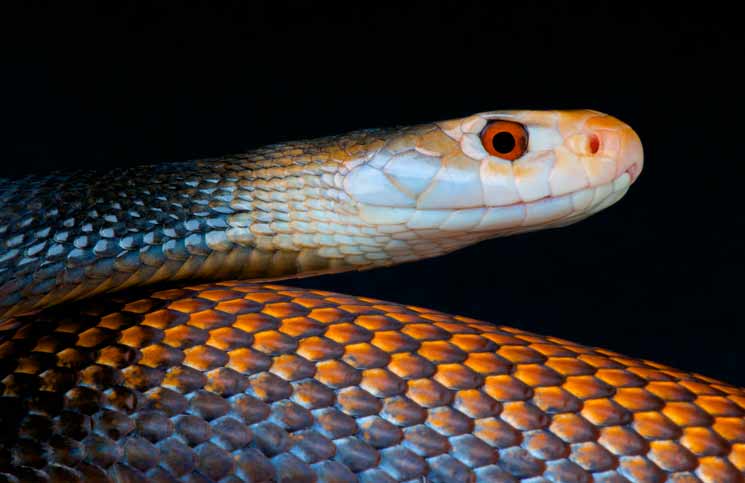
The Taipan Snake is one of the most venomous snakes in the world. The Australian Venom Research Unit even ranks it as the world’s most venomous. Its venom is fifty times more toxic and thus deadlier than that of the Indian cobra, and one single drop of it can kill 100 men. If you are a snake enthusiast, then you may know that a bite of the Indian cobra can be fatal and then you should imagine what a bite of the Taipan can do to you. Considering that, do you really wish to try catching a Taipan snake?

If you do wish to go ahead with your plan of catching a Taipan snake, then you have some good news as well. Despite its venom and its two to three meters length, the snake is a recluse. It may lurch around but it usually doesn’t bite. It is not an aggressive predator when it comes to humans. A Taipan is likely to remain in its own world and not bother you much, unless you meddle with it, or try to catch it!

Almost all cases of Taipan bites have been reported amongst herpetologists or those who tried to catch it or hold it up. In 2012, a 57-year-old Australian who was working in dense bushland near Yeppoon, 430 miles north of Brisbane, died from a Taipan bite. However, in other cases of Taipan bites – the timely administration of the anti-venom had saved all who had been reportedly bitten by a Taipan snake, including a twelve year old boy in Australia who had incidentally caught one and held it around his neck and was heading to his granddad’s house to show the snake. The boy had also chopped off the head of the snake after being bitten.

Taipan Snake
The Taipan Snake: Is this No. 1? Photo: Matthijs Kuipers
Here’s a brief guide to catching a Taipan snake.
  • First, you have to be in the region where Taipans thrive. That would be central or eastern Australia. The state of Queensland and its inland regions are a good place to start with. You may also hit the suburban Brisbane areas or a little up northward along the coast. There are two types of Taipans, inland Taipan and coastal Taipan. You will find both the variants in this region.
  • You need a strategy for catching a Taipan snake. The easiest is to lay a trap after spotting a Taipan. The trap could be the traditional nets or you could contaminate its food, thus drugging the snake when it eats its prey and then you can easily catch it and take it into captivity. But beware of the rigid laws in Australia that prevent you from meddling with species that are endangered and are at the brink of extinction. A Taipan usually eats lizards, rats and bandicoots. You can use these small animals and contaminate them with some drug that would render the Taipan unconscious after its meal. Control the dosage of the drug or poison so you don’t kill the Taipan in the process of catching it.
  • Last but not least – we urge you not to do all of the above. Do NOT attempt to catch a Taipan Snake. It’s dangerous for you, and for the amazing Taipan.

Is This The Fastest Snake In The World?

When it comes to speed, there will always several contenders and various opinions, but in the case of the Fastest Snake in the world, most experts agree. It’s the notorious Black Mamba. Known as the longest venomous snake in Africa and the second-longest venomous snake on the planet, this deadly snake also holds the Speed Title under his belt. Regarded as the fastest snake in the world, it can move at 17.6 feet (5.4 meters) per second and reach amazing speeds of 12 mph (19 KmH)!

This graceful snake can move extremely fast and with astounding agility. However, it can only maintain these high speeds for short distances, and there’s little truth in stories of Black Mambas moving faster than a galloping horse. In many cases when Black Mambas are sighted, their elongated slender body will sometimes creates the impression that it is moving much faster than it really is.

However, the Black Mamba is not only the fastest snake in terms of moving, it is also regarded as one of the fastest striking snakes in the world. This secretive snake will usually avoid danger whenever it can, and when confronted, the Black Mamba will sometimes spread its neck-flap like a Cobra, and expose its terrifying black mouth. However, further enticement by any enemy whatsoever will lead to a series of super-fast and deadly strikes. Thanks to its size, the Black Mamba can raise its head well above ground and might throw a big portion of its body upwards. This provides the snake with a great attacking range, even reaching a standing man’s chest.

fastest snake
Black Mamba. Photo by cd123

Many scientists believe the Black Mamba possesses the most highly evolved venom delivery apparatus in the world, regarded as one of the fast-acting venoms among venomous snakes. Experiments showed how its venom could kill a mouse in only 4.5 minutes. There are also two known cases of Black Mambas killing people in less than 20 minutes!

There’s no wonder why the Black Mamba is regarded as the most feared snake in Africa, where its bite is known as the “Kiss of death”.  The Black Mamba’s extraordinary speed, combined with its fast-striking venom, makes it one of the world’s most deadly snakes.  If you ever happen to take pictures of this snake, make sure to enhance them by using the animals photo editor since you might need to raise the sharpness of the image.